|
|
|
1. |
Crop and Pest
Management Field School
J.D. Green, Plant
and Soil Sciences
The Crop and Pest
Management Field School for private consultants, agribusiness
professionals, and producers is scheduled for June 30, 2005 from 8:30
am to 4:00 pm at the UK Agronomy Research Farm near Lexington,
Kentucky. Topics to be covered include: Herbicide Symptomology on
Grain & Horticultural Crops; Weed Identification; Insect Problems,
Identification, & Management; Corn Growth and Development Stages;
Soybean Production, Soybean Rust, & Other Foliar Diseases; and
Phosphorus Losses in Agricultural Soils.
Preregistration
of $10.00 is requested by June 17 to participate in this training
program. This educational training session has been approved for
Certified Crop Advisers CEU credits (3 hrs Pest Management, 2 hrs Crop
Management, and 1 hr Soil & Water). CEU credits for Pesticide
Applicator Training recertification have also been requested.
The UK Agronomy
Research Farm (Spindletop) is located at 3250 Ironworks Pike (Hwy
1973) on the north side of Lexington between Newtown Pike (Hwy 922)
and the Kentucky Horse Park. The preregistration form is linked at the
Agronomy Extension website:
http://www.uky.edu/Ag/Agronomy/Extension/.
return to top
|
|
2. |
Soybean Rust
on Volunteer Soybeans
Chad Lee,
Plant and Soil Sciences
Soybean Rust was
confirmed on volunteer soybeans in the southwestern Georgia on April
27, 2005. As soybean rust scouting continues, be sure to check in with
the University of Kentucky Soybean Rust website at: www.uky.edu/SoybeanRust.
This website contains all of the national links as well as information
specific to Kentucky. If you have questions or concerns regarding
soybean rust, be sure to contact your county agent.
return to top
|
|
3. |
Soybean
Production Practices for Soybean Rust
Jim Herbek and
Chad Lee, Plant and Soil Sciences
The potential
threat of soybean rust this year is on the minds of soybean producers.
In discussions with producers, some are considering a change in their
production practices because of the potential threat of this disease.
Most production
factors will not affect whether a field does or does not become
infected with soybean rust; however, a change in certain production
practices could reduce yield potential, even if soybean rust is not
present. The best management approach to this disease is to use
production practices that will maximize yield potential. If rust
occurs, the additional costs for fungicides will be a worthwhile
investment to protect that high yield potential.
Production
practice changes being considered by some producers are: soybean
varieties/maturity groups, planting date, row spacing, and plant
populations.
Soybean
Variety/Maturity Group.
Currently, there
are no varieties available with resistance to soybean rust and it will
be at least 5 to 10 years before resistant varieties are developed.
Therefore, select varieties with maximum yield potential, based on
performance tests, from maturity groups that are adapted to your area
or region. In Kentucky, adapted varieties include those from late MG
III, MG IV, and early MG V for various regions of the state.
While selecting
varieties from ultra-early maturity groups may possibly allow the crop
to avoid rust (assuming rust will come late in the season), the yield
potential of these unadapted maturity groups is reduced. Even without
soybean rust, their yield would be less than that of varieties from
adapted maturity groups.
Planting Date.
Plant
during the optimum planting period. Begin planting when soil
temperature is at least 60 to 65° F to promote rapid emergence and
uniform stands. This usually occurs from late April to early May in
Kentucky. Complete planting by early June to avoid a yield decline.
While extremely
early plantings before soil temperature reaches 60° F may allow the
crop to avoid rust (assuming rust will come late in the season),
planting date studies show no yield advantage (and often a yield loss)
for extremely early plantings over traditional planting dates. With
very early plantings, stand uniformity and plant vigor is often
reduced.
Spreading out
planting dates within the optimum planting period (along with some
variation in soybean variety maturity) is a good practice that would
result in differential stages of soybean development among your
fields. If soybean rust occurred, this would provide a better
opportunity (particularly with limited sprayer capacity) to spray
soybean acres in the time necessary to protect yield. Based on
experiences in Brazil, and unless our experience in the U.S. proves
otherwise, significant rust infection usually does not occur until R1
(beginning bloom) and fungicide applications prior to R1 are usually
not beneficial.
Row Spacing.
There
was a 12 to15% average yield advantage for narrow rows (15 inches or
less) in previous row spacing research at the University of Kentucky.
This yield advantage was greater in high yield environments and also
greater and more consistent in late (double-crop) plantings. The great
majority of soybeans are planted in narrow rows in Kentucky.
Some producers
are considering a switch back to 30-inch rows to better facilitate
equipment for late-season spray applications. The yield loss of
run-over rows from sprayer traffic (which will vary according to
sprayer boom width) in narrow row soybeans; however, will be much less
than the yield gained for using narrow rows. A good alternative, by
coordinating planter and sprayer size, is to establish skip-rows
(unplanted rows) in your narrow row system to facilitate wheel tracks
for late-season spray applications. The yield loss for unplanted rows
would be very minimal (or non-existent) with a slight savings in seed
costs.
Even without
soybean rust, wide rows would have a 5 to 6 bu/acre yield
disadvantage. If soybean rust occurs, the yield advantage for narrow
rows should more than compensate the cost of a fungicide application
to protect that yield gain.
Plant Population.
While
soybean populations most likely it will not have a significant impact
on rust, many farmers are using excessive seeding rates. Now may be a
good time to reduce seeding costs.
Studies have
shown that soybean plant populations as low as 100,000 plants per
acre, in many cases, yield as well as 200,000 plants per acre.
Reducing seeding rates to achieve final plant densities of 110,000 to
130,000 plants per acre would result in a seed cost savings of over
$10 per acre, particularly with higher priced seed. If soybean rust
occurs, the seed cost savings could be better invested in fungicides.
return to top
|
|
4. |
Control Seed
Costs to Manage Profit Margin
Sam McNeill,
Biosystems and Agricultural Engineering
Typical seed
costs on a per acre basis can vary between $40 to $70 for corn and $20
to $50 for soybean, depending on the desired plant population,
variety, seed quality and seed cost per bag. A spreadsheet tool has
been developed to help farmers and crop managers easily calculate
their actual costs and easily compare total costs for two seeding
rates for a number of different varieties.
By entering seed
tag data (weight per bag [for corn] or number of seeds per pound [for
soybeans], seed germination and purity) and a desired plant
population, the weight and number of seed per acre is calculated along
with the weight of seeds in a 200-ft planter calibration strip.
Enter the number
of acres for each variety and cost per bag of seed to compute the
number of bags needed for each variety, cost for each variety/seed lot
and per acre cost, as well as the total acres, number of bags and seed
cost for the grain enterprise and average cost per acre.
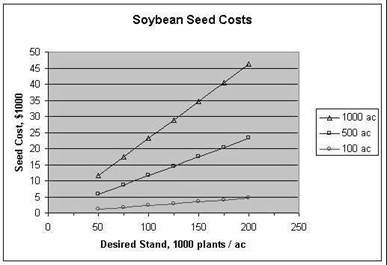
Figure 1 shows a
typical range in RR soybean seed costs at different plant populations
for 100, 500 and 1000 acre operations. Note that the cost difference
between desired stands is $23.16 per 1000 plants/100-acres for this
specific mix of seed quality and varieties.
Table 1
illustrates an example comparing soybean seed costs for 140,000 and
175,000 plants per acre for four different varieties on a 500 acre
farm. Note that the difference between these populations is a little
over $4050 or $8.10 per acre for the entire in this example. Growers
are encouraged to use this spreadsheet tool to help record and control
seed costs. It can be used to quickly calculate seed costs for other
scenarios with corn, soybean or wheat and is available on the web at
www.bae.uky.edu/ext/Grain_Storage/Calculators/.
Figure 1.
Typical range
in RR soybean seed costs at different plant populations for 100, 500
and 1000 acre operations.
|
Variety |
Lot |
No.
seeds
per
lb |
gm
per
1000
seeds |
Germ.
% |
Purity
% |
Table 1.
Illustration of the calculator for comparing soybean seed costs
for two different plant populations, based on seed tag/bag data
(seeds per pound, germination and purity) and the seed cost per
bag (50-lb unit). The number of acres for each variety is also
entered to calculate the total number of bags needed for each
population and the total and average seed cost. A calculation is
also made for a drill or planter calibration at both seeding rates
(weight and number of seeds per acre and weight of seed [grams] in
a 200-ft strip). |
|
SBxx1 |
BR-549 |
3500 |
129.6 |
90 |
98.0 |
|
SBxx2 |
BR-abc |
3000 |
151.2 |
85 |
98.0 |
|
SBxx3 |
BE-def |
3000 |
151.2 |
90 |
98.0 |
|
SBxx3 |
BR-xyz |
2500 |
181.4 |
90 |
98.0 |
|
Compare
seed costs at two different plant populations. |
|
|
|
|
Desired stand |
Row
Spacing
in |
Plants
per
ft |
lbs
seed
per acre |
actual
seeds
per
acre |
gm
per
200 ft
of row |
No.
acres |
No.
50 lb
bags |
Cost |
|
1000/ac |
plants/sq ft |
per
bag |
per
seed lot |
per
acre |
|
140 |
3.2 |
7.5 |
2.0 |
|
|
|
|
|
45 |
158,730 |
59 |
125 |
113 |
$28.00 |
$ 3,175
|
$ 25.40
|
|
|
|
|
|
56 |
168,067 |
73 |
125 |
140 |
$28.50 |
$ 3,992
|
$ 31.93
|
|
|
|
|
|
53 |
158,730 |
69 |
125 |
132 |
$30.00 |
$ 3,968
|
$ 31.75
|
|
|
|
|
|
63 |
158,730 |
83 |
125 |
159 |
$32.00 |
$ 5,079
|
$ 40.63
|
|
|
|
|
|
|
|
Total |
500 |
544 |
|
$ 16,214
|
$ 32.43
|
|
|
|
Desired stand |
Row
Spacing
in |
Plants
per
ft |
lbs
seed
per acre |
actual
seeds
per
acre |
gm
per
200 ft
of row |
No.
acres |
No.
50 lb
bags |
Cost |
|
1000/ac |
plants/sq ft |
per
bag |
per
seed lot |
per
acre |
|
175 |
4.0 |
7.5 |
2.5 |
|
|
|
|
|
57 |
198,413 |
74 |
125 |
142 |
$28.00
|
$ 3,968
|
$ 31.75
|
|
|
|
|
|
70 |
210,084 |
91 |
125 |
175 |
$28.50
|
$ 4,989
|
$ 39.92
|
|
|
|
|
|
66 |
198,413 |
86 |
125 |
165 |
$30.00
|
$ 4,960
|
$ 39.68
|
|
|
|
|
|
79 |
198,413 |
103 |
125 |
198 |
$32.00
|
$ 6,349
|
$ 50.79
|
|
|
|
|
|
|
|
Total |
500 |
681 |
|
$ 20,267
|
$ 40.53
|
|
|
|
|
|
|
|
|
|
|
|
|
|
|
|
|
|
|
|
|
|
|
return to top
|
|
5. |
Predicting
Soybean First Flowering Date
Chad D. Lee,
Dennis B. Egli and James H. Herbek, Plant and Soil Sciences
Soybean first
flowering date appears to be a critical time for managing Asian
Soybean Rust. Observations from Brazil indicate that soybean rust does
not infect soybeans until sometime at or after first flowering, even
when spores are present at earlier soybean growth stages. Based on the
observations from Brazil, we expect most soybean rust infections to
occur sometime after first flowering in the United States. As a
result, we would expect most fungicide applications to occur sometime
after first flowering.
A crop simulation
model (CROPGRO-soybean) was used to predict when soybeans will first
flower in Kentucky. Weather data from the University of Kentucky
Spindletop Farm was used as input, and first predicted flowering dates
were compared with measured dates from several experiments to be sure
that the model was accurate.
Flowering date
will vary year to year, depending on weather conditions. The variation
for first flowering date is greater for soybeans planted early than
for soybeans planted late. As a result, we recommend that farmers and
field scouts begin checking fields ten days prior to the predicted
first flowering dates in Table 1.
The predicted
first flowering dates can be adjusted depending on relative maturity
of a soybean variety and location of the field. Soybean varieties in
the early part of a maturity group category (such as a 4.1 relative
maturity in Maturity Group IV) will likely reach first flowering a few
days earlier than the predicted date, while soybean varieties in the
later part of the maturity group category will likely reach first
flowering date a few days after the predicted date.
Flowering depends
on both daylength and temperature, so the predicted dates may occur
slightly earlier in western Kentucky where temperatures are
historically slightly warmer. Farmers in western Kentucky and the two
southern tiers of counties may want to adjust the predicted first
flowering dates ahead two or three days from those presented in the
tables.
More information
on predicting soybean flowering dates is available in AGR-184:
Predicting Soybean First Flowering Date, a new Extension
publication. This new publication is available online at www.uky.edu/Ag/GrainCrops/
and is available at any Kentucky County Extension Office.
Table 1.
Predicted
first flowering date for different maturity groups and planting dates
in Kentucky.
|
|
|
Soybean
Maturity Group |
|
|
|
Planting
|
MG II |
MG III |
MG IV |
MG V |
|
|
|
Date |
Predicted
First Flowering Date |
|
|
|
|
mean1 |
SD2 |
mean |
SD |
mean |
SD |
mean |
SD |
|
|
|
|
|
(±) |
|
(±) |
|
(±) |
|
(±) |
|
|
|
May 1 |
June 3 |
2 |
June 8 |
4 |
June 17 |
4 |
June 25 |
5 |
|
|
|
May 15 |
June 15 |
2 |
June 21 |
2 |
June 29 |
3 |
July 8 |
3 |
|
|
|
May 29 |
June 27 |
2 |
July 5 |
1 |
July 12 |
1 |
July 19 |
2 |
|
|
|
June 12 |
July 10 |
1 |
July 16 |
1 |
July 23 |
1 |
July 29 |
1 |
|
|
|
June 26 |
July 24 |
1 |
July 29
|
1 |
Aug 2 |
1 |
Aug 8 |
1 |
|
1.
Average flowering date for 29 years of weather data.
2.
Standard deviation.
return to top
|
|
6. |
Northern Corn
Leaf Blight, Planning for 2005
Paul Vincelli,
Plant Pathology
Northern leaf
blight (NLB) was more severe in Kentucky in 2004 than in any year
since the early 1990s. The cool, wet, cloudy weather that prevailed
during most of the 2004 season in many areas played a major role in
disease development. Wet weather with temperatures in the range of 64
to 81oF favors infection and spore production by the fungus
that causes NLB (called Setosphaeria turcica, but also known as
Exserohilum turcicum and Helminthosporium turcicum).
Furthermore, the extended cloud cover makes plants from a susceptible
corn hybrid even more susceptible to the disease.
Although unusual
weather was only part of the picture, my concern is that there are
some indications of a possible trend of increasing pressure from NLB.
Records from the UK Plant Diagnostic Laboratories indicate that this
disease has increased over the past four to five years. A respected
and highly experienced corn pathologist from a neighboring, major
corn-producing state reported similar observations to me. The weather
in 2004 certainly played a role in the severe outbreaks observed, as
explained above.
At this time we
don’t know the complete reason for the apparent increased severity of
NLB over the past several years. It could be due to a new race of the
fungus or it could be due to an unintended decline of partial
resistance in the currently available hybrids to NLB as breeders have
focused on other priorities. It may simply be due to prevailing
weather patterns. This issue is currently being researched by
pathologists in the Midwest; I’ll know more in a few months.
Some Biology of
NLB.
Symptoms of NLB are elliptical, grayish-green or tan lesions 1 to 6
inches long with smooth margins. The large ones are typical for a
susceptible hybrid growing under cool, cloudy, wet conditions. During
damp weather, greenish-black fungal sporulation is produced in
lesions. Older leaves are affected first. Severely affected leaves can
be killed when lesions join together.
The S. turcica
fungus survives in undecomposed corn residue. Spores are spread by air
currents. Severe yield loss can occur when upper leaves become
blighted during early grain fill. Strains of the fungus also infect
sorghum, johnsongrass, and sudangrass, although strains that attack
these plants do not attack corn.
Factors That Can
Favor NLB Development
1. Cool, wet,
cloudy weather, as mentioned above.
2. Reduced
tillage, since the fungus survives in undecomposed leaves of diseased
corn.
3. Continuous
corn, which favors a buildup of inoculum by repeatedly planting a
host.
4. Substantial
late-season growth of volunteer corn after harvest (often occurs after
an early harvest followed by mild temperatures).
5. Late-planted
crops can be exposed at a relatively young age to spore clouds coming
from earlier-planted crops, resulting in more yield loss than in an
earlier crop.
6. Irrigation,
since this provides the humidity and leaf wetness that favors the
disease.
Management.
Producers should be aware of the level of susceptibility to NLB for
all hybrids planted in 2005, but especially in or near fields under
conservation tillage where NLB occurred this past season. Recent
studies by Dr. Pat Lipps from The Ohio State University suggest that
the levels of partial resistance among many, perhaps the majority, of
hybrids without Ht genes is quite low. Work continues on the
question of how much partial resistance exists in the corn hybrids on
the market, but the data from Dr. Lipps certainly raise flags, given
the high inoculum levels that are now present on many farms.
The law of
averages suggests that 2005 season is not likely to be as cool,
cloudy, and wet as this past season, in which case many producers
would “dodge a bullet”. However, with the high inoculum levels that
are present in certain areas, especially in western Kentucky, a
repeat of the same kind of weather could result in destructive
epidemics on susceptible varieties in some localities.
There are two
types of resistance to NLB: complete resistance (more or less) and
partial resistance. In hybrids with partial resistance, fewer lesions
form and they are smaller and with less sporulation than on a
susceptible hybrid.
In hybrids with
(nearly) complete resistance, lesions which form are yellow and
limited in size, and sporulation by the fungus is very limited. These
are hybrids with one or more Ht genes. For example, on hybrids
carrying an Ht1, Ht2, or Ht3
resistance gene, long, yellow to tan lesions with wavy margins and no
sporulation are observed on leaves infected with S. turcica.
These lesions are a resistance reaction and can be easily confused
with Stewart's wilt. The HtN gene results in lesions that are
necrotic, but these lesions are smaller and much delayed compared to
lesions on susceptible hybrids. More commonly, corn hybrids have
partial resistance. In that case, NLB can still develop on the hybrid
but it usually does so more slowly that on a fully susceptible
variety.
Under many
circumstances, a moderate to high level of partial resistance would be
sufficient to control the disease. However, when exposed to high or
very high disease pressure, a hybrid with complete resistance would
often outyield a partially resistant hybrid. Consider the factors
discussed in the preceding section to decide which fields might need a
substantial level of resistance to NLB in 2005.
Conclusion.
While
sowing fear is not my usual educational style, I am very concerned
about the potential risk for serious damage from NLB in 2005. The key
here is that this is potential risk, since we don’t know if the
weather will favor disease development. In the meantime, I encourage
producers to pay close attention to the level of NLB resistance in the
hybrids they choose, especially for late plantings and particularly
for use in or near fields that had serious damage this past season.
Thanks to Bill
Meacham of Pioneer Hi-Bred for observations of the association of
volunteer corn with NLB.
return to top
|
|
7. |
Fungicides for
Use Against Northern Leaf Blight
Paul Vincelli,
Plant Pathology
Since corn
hybrids have been selected and much corn has been planted, there are
some management options should epidemics of northern leaf blight (NLB,
caused by the fungus Setosphaeria turcica) occur in 2005.
Inoculum levels are high in many fields, and if sustained periods of
unusually cool, wet weather occur, which would favor the development
of NLB, we could see very damaging outbreaks in fields without
adequate resistance.
If a combination
of crop rotation and hybrids with moderate to high NLB resistance were
selected, then there should be no reason to spray a fungicide.
However, there could be isolated instances where the producer may see
a benefit to the application of a fungicide. For example, imagine a
field sown to a susceptible hybrid that has a 180+ bushel/acre yield
potential within two weeks on either side of tasseling. If that field
is showing large (3-6 inches) lesions indicative of a susceptible
reaction of NLB on or above the ear leaf, and the long-term forecast
calls for continued cool, wet weather, it may be worthwhile to protect
the high yield potential by applying a fungicide. Such cases would be
few in number, but they may occur, depending on the weather.
Fungicide
Options.
There are several
fungicides labeled for use against NLB. Based on the research I have
seen, the most effective against this disease is Quadris Flowable®. If
applied once at 9.2 to 15.4 fl oz/acre rate, a producer would pay
about $21.56 to $36.09 for the product and $7.50 to $8.00 per acre for
aerial application (assumes a product price of $300/gal). Be aware
that the label requires a minimum application volume of 5 gal/acre in
grain crops. I’ve seen indications of yield losses of anywhere from 5
bu/acre to 50 bu/acre from NLB on susceptible and moderately
susceptible hybrids during the 2004 season. Given the above cost
estimates for applying Quadris7,
one would have to avert a yield loss of at least 14 to 21 bu/acre to
break even for the costs of applying fungicide (assuming a $2.25 /bu
crop value). Quadris has a seven-day pre-harvest interval for field
corn.
Tilt® (or
PropiMaxEC®), which has the same active ingredient) also can be
applied for control of NLB, but in the research I have seen indicates
that Tilt is not consistently as effective as Quadris. When applied
once at 2to 4 fl oz/acre, a producer would pay $5.59-11.19 /acre for
the Tilt7
and $7.50 to 8.00 for application costs (assumes a product price of
$358/gal). Like Quadris, Tilt has a restriction of a minimum of 5
gal/acre when applied aerially. Other important label restrictions
include: (1) Tilt may not be applied after silking, and (2) there is a
30-day pre-harvest interval in field corn.
Stratego®, a
pre-mix of propiconazole and trifloxystrobin, is labeled also for NLB
control. I am aware of only one 6-year old field test evaluating the
performance of Stratego specifically for NLB control, and that test
does not include rates on the current label. Therefore, I can’t make a
definitive statement about its relative efficacy against this disease.
When applied at 10 to 12 fl oz/A, a producer would pay $11.72
to14.06/acre for the Tilt and $7.50 to 8.00 for application costs
(assumes a product price of $150/gal). Among several restrictions
indicated on the label is the prohibition against application to field
corn after silking.
Products
containing chlorothalonil (Bravo®, for example) or mancozeb (Dithane®,
etc) are labeled for NLB control. However, research shows these
contact fungicides are not as effective as either systemic fungicide
listed above. Furthermore, it seems likely that the incomplete
coverage of leaf surfaces that one expects with aerial applications
would be a serious limitation for these two contact fungicides.
Note that for
several of these fungicides, the disease is called “Helminthosporium
leaf blight” caused by Helminthosporium turcicum, an old name
for the fungus that causes NLB.
Potential
Benefits of Fungicide Application in Limited Instances.
In the situation
of high disease pressure described above, one would probably at least
recoup the cost of a fungicide application, and exceed it in some
instances. In addition to protection of yield, if NLB is “brewing” in
a susceptible hybrid, a fungicide application could help protect test
weight and stalk quality. When leaves are blighted during grain fill,
the corn plant draws reserves out of the stalk in order to fill the
grain. This results in weak stalks susceptible to lodging. Thus, some
producers may feel a fungicide treatment is justified on the basis of
retention of stalk quality. The application might allow the producer
to let the crop dry down for a time in the field, instead of having to
rush in to harvest at black layer and dry the corn down from 30 to 35%
moisture concentration, resulting in less flexibility in scheduling
harvests, higher drying costs, and increased risk of stress cracks
from drying operations.
There are no
simple answers as to whether a fungicide application will be worth
applying. So much depends on complex factors that are often
unpredictable. However, perhaps these comments will help producers
think through some of the ramifications of applying a fungicide if
faced with a NLB outbreak this year.
return to top
|
|
8. |
Resistance
Management Grouping Codes Now Appearing on Some Pesticide Labels
Ric Bessin, Kenny
Seebold, Doug Johnson, and Lee Townsend,
Entomology and
Plant Pathology
In an effort to
make management of pesticide resistance easier for pesticide users,
some companies have begun to place mode-of-action classification codes
on the front of their pesticide labels. These designations appear as a
three part box, as in the examples below:
|
GROUP |
1B |
INSECTICIDE |
or |
GROUP |
11 |
FUNGICIDE |
These
classification schemes for insecticides and fungicides provide growers
with an easy to recognize numerical group for a particular pesticide
based on its mode of action. Pesticide products with multiple modes of
action will multiple classifications listed. These numerical schemes
should make identifying pesticides with the same modes of action
simpler and should help pesticide avoid the overuse of a single class
of pesticide.
Generally, the
more frequently a grower sprays the same mode of action to control a
pest problem, the more quickly a pest is likely to develop resistance.
Many factors affect the rate of pesticide resistance development and
most of those are out of our control (development rate of the pest,
migration rate from susceptible populations, background levels of
resistance), but we can control judicious use of pesticides and
rotation of chemicals with different modes of action when repeated
applications are needed.
Keys to using
this system correctly:
v
Read and recognize the numerical groups on the pesticide labels. Those
with different designations have different modes of action.
v
To
delay and/or prevent the development of resistance by pests, growers
must avoid the repeated use of the same mode of action. Users need to
alternate different pesticide classes periodically when repeated
sprays are needed. Alternate products from different numerical groups
for repeated applications.
v
Do
not tank mix to pesticides from the same numerical group (same mode of
action).
v
As
always, only use pesticides at labeled rates and according to labeled
spray intervals.
Other factors
that delay the development of pesticide resistance:
v
Always time pesticide sprays when they will do the most good. Most
pests have a stage when they are most vulnerable. Don’t wait too long
to begin applications of pesticides. In the case of fungicides,
“rescue” applications of chemicals to severely diseased fields can
lead to the development of resistance in pathogen populations (more of
the pathogen population is exposed to the fungicide and therefore the
odds of selecting for resistant individuals go up).
v
Take an integrated approach to pest control and maximize the utility
of proper cultural controls, crop rotation, resistant varieties, and
natural enemies of pests.
v
Use
pest and weather monitoring and economic thresholds as guides when
making decisions to make pesticide applications.
v
Try
to preserve natural enemies of pests through the use of selective
pesticides or targeted applications.
v
Mix
and apply pesticides carefully to ensure correct dosage and coverage.
Sprayers must be calibrated regularly to account for nozzle wear. Use
the proper spray volumes and pressure to ensure adequate coverage.
v
Eliminate crop residues after harvest when practical to remove
overwintering sites for pests.
return to top
|
|
9. |
Corkscrew Corn
Chad Lee, Plant
and Soil Sciences
Reports have come
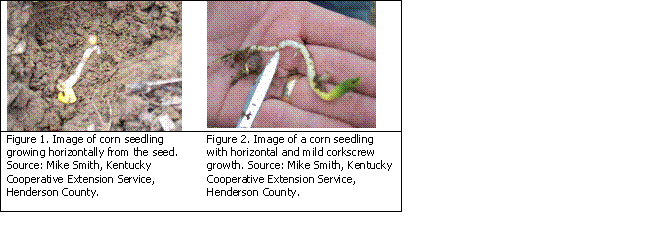
in of twisted or corkscrewed and horizontal corn seedlings beneath the
soil surface. For normal seedlings, the white portion of the shoot
which comprises the mesocotyl and coleoptile grows nearly straight
upward toward the soil surface. For corkscrew and horizontal
seedlings, the shoot does not grow straight to the soil surface but
resembles a corkscrew or remains horizontal under the soil surface
(Figures 1 and 2). In some instances, the seedling will not make it
through the soil surface and leaves could unroll underground. There
are several factors that may cause twisted or horizontal shoots.
 |
Cool
Weather.
Soil temperatures
less than 55 degrees Fahrenheit for an extended period or rapid
changes in temperatures, such as air temperatures in the 80s and
dropping below 55, can cause the twisting. Seed that imbibes water as
cold as 50 degrees Fahrenheit can go through imbibitional cooling,
which can result in corkscrewing. If the coleoptile has already
emerged from the seed, then I speculate that as the coleoptile grows
toward the soil surface until it comes into contact with the cool
temperatures and starts to grow down, then back up and then down again
causing the corkscrewing effect.
Soil Compaction.
Restrictions in the soil around the germinating seed can cause the
mesocotyl and/or coleoptile to grow around the restriction zone.
Sidewall compaction, heavy rains immediately following planting, and
soil clods can all cause restriction zones that result in the twisting
appearance.
Herbicides.
Soil-applied herbicides that are seedling shoot inhibitors (containing
one of the following active ingredients: alachlor, acetochlor,
metolachlor, dimethenamid, or flufenacet) in combination with cool,
wet weather and crusted soils can disrupt proper growth of the shoot.
Since most of these herbicide products are formulated with a safener,
herbicide injury from these products at proper use rates is extremely
rare. However, the cooler temperatures can slow corn growth and
increase herbicide injury. Factors inhibiting or slowing shoot growth,
such as those mentioned above, are usually required before herbicide
injury occurs at proper use rates.
Kernel Position
in the Soil.
As the mesocotyl
elongates, the coleoptile emerges from the embryo side of the seed and
grows toward the dent end of the kernel. If the embryo side is facing
down, then the coleoptile will grow along the kernel until it grows
past the dent end of the kernel. At this point, the coleoptile will
begin growing upward. In greenhouse studies, shoots from kernels with
the embryo facing down require about one more day to emerge then
shoots from kernels with embryos facing up. I would expect cooler
temperatures and soil compaction to delay emergence even more.
Seeing the Light.
Seedlings that manage to “spike” through the soil surface and leaf out
above ground will likely recover from the corkscrew symptoms and
produce an acceptable yield. However, continued cool temperatures and
cloudy skies will slow seedling growth and could limit the amount of
recovery. The cool temperatures and cloudy skies not only slow corn
growth but also favor seedling diseases and insects. Field scouting is
necessary to determine the crop condition and to make management
decisions accordingly.
Sources:
v
Loux, M. 2004. Causes of leafout and underground leaf emergence in
corn. C.O.R.N Newsletter 2005-10, April 25, 2005 - May 3, 2005, The
Ohio State University. URL: http://corn.osu.edu/
v
Nielsen, R.L. 2004.Corkscrewed Corn Seedlings. Corny News Network,
Purdue University. URL: http://www.kingcorn.org/news/articles.04/Corkscrew-0501.html
v
Saab, I. 2005. Stress Emergence in Corn. Crop Insights. vol. 5, no. 6.
Pioneer Hi-Bred International.
return to top
Newsletter Home
Printer Friendly Version (pdf)
|
|
|