| |
|
|
1. |
Marestail (Conyza
canadensis) Control in Soybeans
James R. Martin and J. D. Green,
Plant and Soil Sciences
The glyphosate
resistance issues associated with marestail makes it a challenge to
manage this annual weed in soybeans. If marestail is present, it is
prudent to assume that glyphosate resistance is likely and that
alternative herbicides need to become a part of the weed management
program.
Burndown
applications of 2,4-D ester play a major role in controlling marestail
in full-season no-till soybeans, yet they have their limitations.
One of the primary drawbacks of using 2, 4-D in burndown applications
is the risk of injuring soybeans. In order to minimize the risk,
2,4-D ester must be applied 7 to 30 days ahead of soybean planting.
Treatments of 0.5 lb ae (acid equivalent) per acre, require a minimum
of 7 days between application and planting; whereas, most 2,4-D ester
products applied at rates > 0.5 to 1.0 lb ae/A require a waiting
interval of at least 30 days. The label directions on rates and
waiting periods may vary depending on specific product.
The following list
of 2,4-D ester products illustrates the differences in formulations
and recommended label directions concerning rates and waiting period
between application and planting of no-till soybeans.
Table 1.
Examples of
products containing 2,4-D and waiting periods between spraying and
planting soybeans.
clomid and acne
clomid no periods
cipro birth control
clomid and soy isoflavens
what dose of celexa
diflucan in dextrose
clomid and weight gain
|
PRODUCT
(formulation) |
WAITING PERIOD |
|
7 days |
30 days |
|
Salvo (5 lb
ae/gal) |
12.8 oz/A |
* |
|
Weedone (LV
4EC) (3.84 lb ae/gal) |
1 pt/A, 16.6
oz/A |
2 pt/A, 33.3
oz/A |
|
Weedone (LV6)
(5.4lb ae/gal) |
0.67 pt/A |
1.33 pt/A |
|
Weedone 638
(2.8lb ae/gal) |
1.33 pt/A |
2.67 pt/A |
|
* Salvo
applied at 25.6 oz/A requires a minimum waiting period of 14 days. |
While the
persistence of 2,4-D in soil is considered a risk to injuring
soybeans, it is not great enough to provide long-term preemergence
control of marestail following burndown applications. Under the right
conditions in Kentucky, marestail can emerge throughout much of the
summer; consequently, newly emerging seedlings following burndown
applications could potentially become a problem.
The following
comments may help growers who are trying to manage marestail this
spring:
 1)
Monitor fields 1)
Monitor fields
Monitor fields well
in advance of soybean planting for emergence and size of
marestail. Ideally burndown treatments with 2,4-D ester should be
applied before marestail exceeds 6 inches in height. The
emergence and growth patterns of marestail will vary depending on
residue cover and the growing season. Based on the observations
from various studies in western
Kentucky
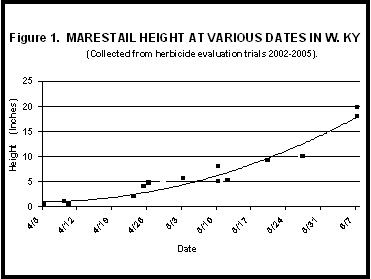
during the last few years, marestail reaches 6 inches around the first
week of May (see Figure 1). Ideally burndown treatments with 2,4-D ester should be
applied before marestail exceeds 6 inches in height. The
emergence and growth patterns of marestail will vary depending on
residue cover and the growing season. Based on the observations
from various studies in western
Kentucky
during the last few years, marestail reaches 6 inches around the first
week of May (see Figure 1).
2) Soil-residual
herbicides
When applying well
in advance of soybean planting, consider including a soil-residual
herbicide such as Canopy (chlorimuron + metribuzin), Canopy EX
(chlorimuron + tribenuron), FirstRate (cloransulam), Sencor
(metribuzin), or Valor (flumioxazin) to provide preemergence control
of marestail plants. The fact these options offer alternative
mode(s) of action compared with glyphosate is another benefit for
including them in the overall management of marestail
3) Paraquat or
glyphosate
Include paraquat or
glyphosate with 2,4-D as a part of the overall burndown treatment to
control other weeds and help provide additional stress on marestail.
While paraquat alone is not a good option for controlling marestail,
it can be beneficial when using 2,4-D for the burndown control of
small plants. It also provides another mode of action that is
different than glyphosate. However, the benefit of paraquat may
diminish as average plant size increases to 4 to 6 inches in height.
While resistant
marestail plants are tolerant to glyphosate, they usually show some
stunting as an initial response to glyphosate. This herbicidal
activity along with that from the 2,,4-D ester can be helpful in
managing marestail.
4) Taller marestail
Achieving consistent
burndown control of marestail diminishes when plants exceed 6 inches
in height. If plants exceed this height, consider applying 2,4-D ester
at the high rate and include glyphosate along with FirstRate, or
Canopy. Using the high rate of 2,4-D ester (1 lb ae/A) can
improve control but the extra time in delay planting of soybeans
is an obvious draw back when applying this rate.
5) ALS-resistance
Be on the look out
for ALS-resistant marestail. Although this type of resistance
has not been confirmed in
Kentucky,
there are cases of it in Ohio and Indiana. FirstRate, Canopy EX,
Classic (chlorimuron), and Synchrony XP (chlorimuron + thfensulfuron)
are examples of ALS–containing products that will not control ALS-resistant
marestail.
6) No-till
double-cropped soybeans
There are no good
options for managing glyposate-tolerant marestail in no-till
double-cropped soybeans. The best defense is to have a good
stand of wheat to limit the emergence and growth of marestail.
Marestail will probably be more of a problem in double-cropped
soybeans this season due to erratic wheat stands caused by the dry
weather during wheat planting last fall.
(return to top)
|
|
2. |
Time- A Key to
Managing Soybean for High Yields
D.B. Egli, Plant and Soil Sciences
Time permeates our
lives. There is not enough time. It takes too much time. I don’t have
enough time. I’m not on time. Time seems to rule our very existence
and it is difficult to escape from this constant obsession with time.
Perhaps it is not surprising that time is also an important part of
soybean production – we can’t forget about time if we want to produce
high soybean yields.
There are two
important aspects of time in soybean production that I want to
discuss. The first relates to the growth of the plant – what is it
doing and when is it doing it? The second relates to the producers’
activities – what are they doing and when?
Soybean plants (and
all other grain crops for that matter) go through three phases of
growth: first they grow vegetatively, producing stems, leaves and
roots, then they start flowering and setting pods, and finally, the
seeds grow and fill the pods and the crop is ready to harvest. In a
sense, the crop first produces the machinery (leaves, stems, roots) to
produce yield, then the container for yield (pods and seeds), and
finally it fills the container (seed filling). Surprisingly, most of
the soybean plant’s life is devoted to preliminary events, growing
leaves and setting pods, while the seeds and yield are produced only
during the final stages of growth. Only about 30% of the time from
planting to physiological maturity is actually used to fill the seeds.
Following the
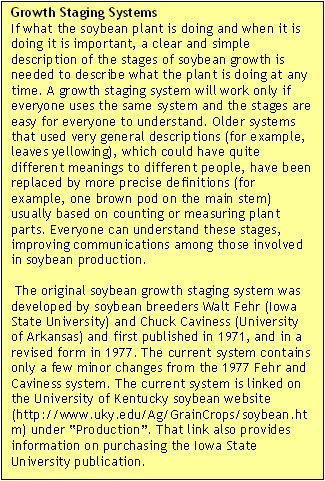
soybean growth staging system (a system that all producers
should be familiar with, the box at the end of this article contains
more details), flowering and pod set begins at growth stage R1
(beginning bloom – one open flower at any node on the main stem) and
ends at roughly growth stage R5 (beginning seed – seed 3 mm (1/8 inch)
long in a pod at one of the four uppermost nodes on the main stem with
a fully developed trifoliolate leaf, i.e., a leaf that has unrolled
sufficiently so that the edges are not touching). Vegetative growth
continues during flowering and pod set, but both end at the beginning
of seed filling. Seed filling begins at R5 and ends at growth stage R7
(beginning maturity – one normal pod on the main stem has reached its
mature pod color, brown or tan depending on the variety). Seed filling
actually begins a little before R5 and pod set continues for a while
after R5, but R5 is a good indicator of the change from one phase to
the other. Growth stage R7 is a good indicator of physiological
maturity, defined as maximum seed dry weight.
All the yield is there at growth stage R7, but the seeds are
about 55% moisture, so harvest cannot begin until the seeds dry. These
comments apply, with only subtle differences, to soybean varieties
with indeterminate (generally maturity group IV and earlier with only
a few exceptions) or determinate (maturity group V and later) growth
habits.
Which of these three
phases is most important for high yields? Without a doubt, flowering
and pod set is the most important because the number of pods and seeds
the plant will produce is determined during this stage. Good weather
(plenty of rain) during this period will produce lots of seeds (a
large yield container) which is always the first step to high yield.
The yield container
must be filled, so seed filling is also a very important phase. Stress
(dry weather) during this phase will produce smaller seeds (often
because of earlier maturity) and reduce yield. When stress during
flowering and pod set reduces the number of pods and seeds the plant
can compensate (assuming the weather improves during seed filling) by
making larger seeds. There is a limit to this compensation (no one has
ever seen a soybean seed the size of a baseball or even a golf ball),
so it’s better to have a large yield container than to bet on seed
size.
Surprisingly,
vegetative growth is the least important of the three. Yes, you must
have a certain amount of machinery to produce maximum yield, but most
soybean varieties in narrow rows produce more than enough machinery
(leaves). If you have more than enough you can lose a little without
affecting yield. The key is that there must be enough leaf growth to
provide complete ground cover by flowering or soon thereafter; if you
can see the soil between the rows after flowering (growth stage R1),
yield will probably not be as high as it could be. Stress during
vegetative growth often has no affect on yield, because there are
still enough leaves left to provide complete ground cover. An English
scientist once asked the question “Is your vegetative phase
necessary?” and concluded “Yes, but not as necessary as one might
think”. This conclusion is definitely true for soybean.
The timing of the
reproductive phases – when they occur during the summer- can also be
important. In a good year with lots of rain or in a terrible drought
it won’t make much difference, but in a normal Kentucky summer when it
doesn’t quite rain enough and we get short dry spells, the timing of
flowering and pod set and seed filling can be critical.
We can control time
in some of our management decisions. When to plant and what variety to
use are two decisions faced by all producers. Planting in May or early
June will usually give you about the same yield. Things change about
June 10 to 15 in
Kentucky
and yields begin to decline (~ 1.5 % per day, on average) as planting
is delayed. Paying attention to when you plant can increase soybean
yield without increasing input costs. Double-cropping soybean after
wheat forces us to plant late and that’s why yields are often lower.
Variety maturity and
planting date determine when reproductive growth occurs during the
summer. Approximate dates for growth stages R1, R5 and R7 from May and
late June plantings at
Lexington,
KY are shown in Table 1. If we could get a perfect
weather forecast for the entire summer we would know what variety to
plant and when to plant it to match flowering, pod set and seed
filling with good weather to insure high yields. Such a forecast may
be available in the future, but for now we can only play the averages
that say that generally the yield of maturity group III is roughly 10%
less than group IV varieties in
Kentucky
while maturity group V is, on the average, 10 to 15% less than group
IV. Any advantage for maturity group II varieties is probably pretty
small and they may yield less in some years. There can be, however,
lots of variation among maturity groups in any year, depending on
which one gets the most rain during the critical reproductive growth
phases. Growing varieties from several maturity groups will usually
give more consistent yields from year to year since a short dry spell
will probably not hit the critical phases of all of them.
Time is important in
soybean production. What the plant is doing and when it is doing it
has something to do with yield. Thinking about time and the three
phases of yield production can help you manage your soybean crop and
make it more profitable. Remember, as Charles F. Kettering once said
“Thinking is one thing no one has ever been able to tax”.
Table 1.
Planting date and maturity group effects on timing of reproductive
development, Lexington, KY. Adapted from Egli, D.B. and W.P.
Bruening. 2000. Potential of Early-Maturing Soybean Cultivars in Late
Plantings. Agron. J. 92: 532-537.
|
Maturity |
Early planting (May 18) |
Late planting (June 25) |
|
Group |
R1 |
R5 |
R7 |
R1 |
R5 |
R7 |
|
II† |
June 28 |
July 30 |
Sept. 1 |
Aug. 1 |
Aug. 24 |
Sept. 26 |
|
III
|
July 3 |
Aug. 8 |
Sept. 9 |
Aug. 3 |
Aug. 28 |
Oct. 2 |
|
IV |
July 8 |
Aug. 14 |
Sept.
20 |
Aug. 6 |
Sept. 1 |
Oct. 6 |
|
†
Two varieties per maturity group. Average of three years at
Lexington, KY.
|
(return to top)
|
|
3. |
Early soybeans
in Kentucky
Chad Lee,
Dennis B. Egli and John H.
Grove, University of Kentucky
In Kentucky,
Maturity Group IV (also referred to as ‘group 4’) soybean varieties
typically yield more than soybean varieties in other maturity groups.
Early group 5 soybean varieties in the southern and western part of
Kentucky and late group 3 varieties in central and northern Kentucky
also typically yield well.
Group 4 soybean
varieties planted in May will be filling seed during August, which is
typically a dry month in Kentucky. If water becomes limiting during
seed filling, yields will be reduced. Shallow soils are more prone to
water-limiting conditions than deep soils because shallow soils hold
less water. Group 2 varieties may be a very good fit on shallow soils
by going through seed filling early enough to avoid the typically dry
August period. So, on these drought-prone soils, group 2 varieties may
actually yield the same as, or more than, group 4 varieties.
Studies were
conducted in central Kentucky for the past three years to determine if
group 2 varieties could yield as well as group 4 varieties. The
varieties were planted across several landscape positions. These
positions had different soil depths, which created differences in
drought potential. The backslopes and shoulders have shallower soils
than other slopes and are more prone to drought. The studies did not
experience any extended dry period in 2003 and 2004. In 2005, the only
month with surplus precipitation was August! The past three years did
not follow the long-term weather trends, having a dry August, so we
could not test our hypothesis regarding group 2 varieties on shallow
soils.
Field landscape
position did not significantly affect yield in any of the three years,
but there were significant differences in yield between varieties from
different maturity groups. Group 4 varieties yielded about 10% more
than group 3 and 20% more than group 2 varieties (Table 1). Group 4
varieties yielded about 10% more than group 5 varieties the first two
years, but group 5 varieties yielded about 12% more than group 4
soybeans in 2005. The yield advantage of the group 5 varieties in 2005
was likely due to the late season rainfall in an otherwise dry year.
The earlier-maturing varieties were too mature to benefit from the
late-season rainfall.
Differences in
yield between varieties from different maturity groups were not as
great in the Kentucky Soybean Performance Test. The three highest
yields from each maturity group were averaged and compared to the
three highest yields from the other maturity groups. Group 4 varieties
averaged about 3% and 5% more yield than group 3 and group 5
varieties, respectively. Year-to-year differences in yield fluctuated
some. For example, group 4 varieties yielded more than group 5
varieties in every year but 2005. Again, late-season rainfall
benefited the group 5 varieties.
The expectation
that group 2 soybean varieties will out-yield group 4 varieties on
shallow soils in some years is speculation at this point. However,
farmers considering group 2 varieties for their early harvest and
market advantages should try to plant group 2 varieties on
drought-prone soils when possible. If you try group 2 varieties, it
may be a good idea to have no more than 10 to 20% of your total
soybean acreage in group 2 soybeans. Also, group 2 varieties should be
planted at a full season date (April 15 to May 15) to maximize growth.
Late plantings of group 2 varieties will cause the plants to be too
short and will reduce yield. One other concern with group 2 varieties
is the difficulty in identifying high-yielding varieties for Kentucky.
Group 2 varieties have not been fully tested in the Kentucky Soybean
Performance Test.
Group 2 varieties
may be a useful component to an overall soybean production operation;
however, the current research indicates lost yield potential with
group 2 varieties. Producers are advised to weigh the disadvantages of
reduced yield of group 2 varieties against the benefits of time
management and market premiums for an early harvest.
This research was
funded, in part, by the Kentucky Soybean Promotion Board.
Table 1.
Average yields of two soybean varieties from each maturity group
across landscape near Lexington, KY.
|
|
|
Landscape
Position |
|
|
|
Year |
Maturity |
summit |
shoulder |
back |
foot |
toe |
average |
difference1 |
|
|
Group |
Yield |
|
|
|
|
|
bu/a |
bu/a |
bu/a |
bu/a |
bu/a |
bu/a |
bu/a |
% |
|
2003 |
II |
33.7 |
43.7 |
41.4 |
42.3 |
54.4 |
40.7 |
-10.9 |
-21 |
|
|
III |
45.5 |
49.7 |
44.3 |
46.4 |
45.9 |
46.4 |
-5.2 |
-10 |
|
|
IV |
47.9 |
54.0 |
51.4 |
56.2 |
47.6 |
51.7 |
0.0 |
0 |
|
|
V |
40.7 |
41.7 |
36.2 |
43.6 |
39.5 |
40.2 |
-11.5 |
-22 |
|
|
|
|
|
|
|
|
|
|
|
|
2004 |
II |
31.2 |
29.2 |
33.0 |
32.3 |
32.4 |
31.3 |
-14.6 |
-32 |
|
|
III |
41.4 |
35.7 |
42.4 |
40.4 |
40.5 |
39.9 |
-6.0 |
-13 |
|
|
IV |
49.1 |
49.9 |
39.7 |
41.1 |
47.8 |
45.9 |
0.0 |
0 |
|
|
V |
36.1 |
40.7 |
37.0 |
35.6 |
31.4 |
37.1 |
-8.8 |
-19 |
|
|
|
|
|
|
|
|
|
|
|
|
2005 |
II |
21.2 |
29.0 |
26.9 |
42.2 |
48.6 |
30.9 |
-7.8 |
-20 |
|
|
III |
28.8 |
36.3 |
31.2 |
45.4 |
45.3 |
35.8 |
-2.9 |
-8 |
|
|
IV |
34.6 |
32.9 |
36.9 |
49.5 |
53.1 |
38.8 |
0.0 |
0 |
|
|
V |
41.7 |
41.1 |
41.3 |
55.9 |
36.5 |
43.4 |
4.6 |
12 |
|
|
|
|
|
|
|
|
|
|
|
|
|
|
|
|
|
|
|
1
Comparison between average yield from Maturity Group IV soybean yield
and each other maturity group.
(return to top)
|
|
4. |
Soybean
Populations and Yield
Chad Lee, John H. Grove, Jim Herbek,
Lloyd Murdock and Eugene Lacefield, Plant and Soil Sciences
For several
years, the University of Kentucky has been investigating the effects
of lower plant populations on seed yield. Those studies have indicated
that final plant populations under 100,000 plants per acre are often
adequate for maximum yield (Table 1). The Kentucky Soybean Promotion
Board funded projects to investigate seeding rates and yield in 2005.
All of the studies, to date, were conducted with 15- or 16-inch rows.
Small-plot drills were used to deliver the seed.
The results from
one of the studies conducted in 2005 were mixed. The lowest seeding
rate that reached maximum yield was 80,000 seeds per acre at Lexington
and Princeton and 180,000 seeds per acre at the Western Kentucky
University, Henderson and Marshall locations (Table 2).
The unusual
weather patterns in the 2005 growing season may explain some of the
variability in soybean yield response to seeding rates. The 2005
growing season experienced low rainfall totals for most of the state
(Table 3). August was the wettest month of the summer and it is
typically the driest! Consider the extreme weather of 2005 when
evaluating the results from these seeding rate studies.
In another study
at Princeton, KY, maximum yield was obtained with 50,000 seeds per
acre for two soybean varieties (Table 4). In a separate study at
Lexington, KY, maximum yield was obtained at about 35,000 seeds per
acre for the full season planting dates. However, for the short season
planting dates, maximum yield was obtained at about 122,000 and
190,000 seeds per acre (Table 5). Again, weather played a role in crop
response to seeding rates.
There is evidence
that high yields can be obtained with lower seeding rates in Kentucky.
The dry weather from 2005 does bring into question just how low of a
seeding rate is warranted for maximum yields. There was considerable
variation in the final stand achieved in the 5-location study (Table
6). A final stand of around 100,000 plants was generally needed to
optimize yield (Figure 1), regardless of yield potential.
Even with the
mixed results observed in 2005, we are confident that full season
soybeans at a final stand of 100,000 plants per acre will achieve
maximum yield. Based on the irregular emergence observed in Table 6,
we are much less confident about how many seeds it takes to reach
100,000 plants per acre. The inoculants tested in one study and the
insecticide seed treatments tested in another study did not improve
stands or final yields. Seed vigor, tested in another study, did not
improve stands either.
Concerning short
season planting dates (double crop soybeans), seeding rates at the
highest end of our recommendations are still encouraged (167,000 seeds
per acre for 15-inch rows). We are going to investigate this issue
more.
The results from
studies in 2005 illustrate why the University of Kentucky sometimes
appears slow in changing recommendations. We are trying to gather as
much data as possible to provide the best possible recommendation for
Kentucky producers. We will continue to investigate low populations
and try to better understand why poor emergence occurs some of the
time.
This research was
funded, in part, by the Kentucky Soybean Promotion Board.
|
Table
1.
Minimum population needed for maximum yield from soybeans
planted near Lexington, KY, 2003 and 2004. |
|
Seeding
Date |
Season1 |
Cultivar |
MG |
Minimum
Population2 |
|
|
|
|
|
plants/acre |
|
24-Apr-03 |
Full |
Stressland |
4.5 |
42,500 |
|
24-Apr-03 |
Full |
CF 461 |
4.6 |
53,400 |
|
24-Apr-03 |
Full |
CF 492 |
4.9 |
49,800 |
|
|
|
|
|
|
|
21-May-04 |
Full |
B283 |
2.8 |
92,300 |
|
21-May-04 |
Full |
B336 |
3.3 |
72,100 |
|
21-May-04 |
Full |
CF 461 |
4.6 |
85,800 |
|
|
|
|
|
|
|
21-Jun-04 |
Short |
B283 |
2.8 |
91,400 |
|
21-Jun-04 |
Short |
B336 |
3.3 |
93,100 |
|
1
Full season and short season. The short season was planted
into no-till residue but did not follow wheat.
2
Exponential rise to maximum, 3 parameter model: density
required for 95% of yield that was achieved at maximum plant
density. |
|
|
Table
2.
Seeding rate effect on soybean yields, averaged over inoculant
treatment, 2005. |
|
Location |
Seeding
Rate per Acre (X 1000) |
|
|
20 |
80 |
100 |
120 |
180 |
|
|
Yield
(Bu/A) |
|
Lexington |
26.9 |
29.9 |
30.9 |
31.5 |
28.4 |
|
WKU |
13.2 |
50.3 |
50.8 |
56.1 |
59.6 |
|
Princeton |
26.1 |
53.6 |
53.8 |
53.8 |
53.0 |
|
Henderson |
19.3 |
48.4 |
63.0 |
63.9 |
75.0 |
|
Marshall |
33.4 |
56.0 |
59.9 |
58.2 |
63.5 |
|
|
Table 3.
Rainfall departures from normal for the 2005 growing season. |
|
Location |
Mar |
Apr |
May |
Jun |
Jul |
Aug |
Sept |
Total |
|
|
|
Precipitation
(Departure from Normal, inches) |
|
|
Lexington |
-0.91 |
-0.41 |
-1.83 |
-1.38 |
-1.95 |
+2.17 |
-2.31 |
-6.62 |
|
|
WKU |
-1.58 |
+1.47 |
-2.49 |
-2.30 |
-0.42 |
+4.43 |
-3.25 |
-4.14 |
|
|
Princeton |
-0.83 |
-0.19 |
-3.42 |
-0.76 |
-1.90 |
+7.53 |
-1.16 |
-0.73 |
|
|
Henderson |
-2.03 |
-0.54 |
-1.18 |
-1.45 |
0.00 |
+1.66 |
-0.68 |
-4.22 |
|
|
Marshall
1 |
-1.38 |
-1.24 |
-4.35 |
-0.32 |
-1.63 |
+1.32 |
-2.47 |
-10.02 |
|
|
1
Mayfield data the closest location to Marshall County site. |
|
Table 4.
Seeding rate effect on soybean yield, Princeton, KY, 2005.
|
|
Seeding Rate1
|
Avg. Final
Stand2
|
Soybean Yield2
|
|
(viable
seeds/A) |
(Plants/A) |
(Bushels/A) |
|
50,000 |
45,000 |
73 a |
|
75,000 |
65,000 |
72 a |
|
100,000 |
85,000 |
75 a |
|
125,000 |
110,000 |
73 a |
|
150,000 |
130,000 |
74 a |
|
175,000 |
150,000 |
74 a |
|
200,000 |
175,000 |
74 a |
|
225,000 |
195,000 |
72 a |
|
1Seeded
May, 25, 2005 in 15-inch rows.
2
Avg.
approx. final stand of two varieties.
3
Avg. of
two varieties (3.9 RM and 4.7 RM). Varieties were not
significantly different. |
|
Table
5.
Seeding rate on soybean yield, Lexington, KY, 2005. |
|
Population |
Full
Season |
Short
Season |
|
|
B283 |
B336 |
B283 |
B336 |
|
|
Yield |
|
seeds/acre |
Bu/acre |
|
17,400 |
17.1 |
23.9 |
27.1 |
28.8 |
|
34,800 |
23.9 |
35.5 |
33.4 |
33.6 |
|
70,000 |
15.6 |
35.5 |
38.0 |
38.7 |
|
121,800 |
16.3 |
35.6 |
49.4 |
44.3 |
|
192,000 |
12 |
31.2 |
50.1 |
46.5 |
|
|
|
|
|
|
|
|
|
Table
6.
Seeding rate effect on final soybean stand, averaged over
inoculant treatment, 2005. |
|
Location |
Seeding
Rate per Acre (X 1000) |
|
|
20 |
80 |
100 |
120 |
180 |
|
|
Final
Plant Population (plants/A x 1000) |
|
Lexington |
17.2 |
70.3 |
83.4 |
95.0 |
146.5 |
|
WKU |
12.7 |
49.4 |
58.8 |
69.0 |
126.6 |
|
Princeton |
15.1 |
71.9 |
84.9 |
119.4 |
158.2 |
|
Henderson |
11.6 |
37.6 |
58.4 |
80.0 |
131.5 |
|
Marshall |
17.6 |
69.8 |
95.4 |
99.2 |
121.7 |
|
Figure 1.
Relative yield of soybean to plant population across five locations in
Kentucky, 2005.

(return to top)
|
|
5. |
Control Seed
Costs to Manage Profits
Sam McNeill, Biosystems and
Agricultural Engineering
Typical seed costs
on a per acre basis can vary between $40 to $70 for corn and $25 to
$50 for soybean, depending on the desired plant population,
variety/lot, seed quality and seed cost per bag. A spreadsheet tool
has been developed to help farmers and crop managers easily calculate
their actual costs and easily compare total costs for two seeding
rates for a number of different varieties and/or seed lots. By
entering seed tag data (germination, purity and weight per bag for
corn or number or seeds per pound for soybeans) and a desired plant
population, the weight and number of seed per acre is calculated along
with the weight of seeds in a 200-ft planter calibration strip. Enter
the number of acres for each variety and cost per bag to compute the
number of bags needed for each variety, cost for each variety/lot and
acre, number of bags, seed cost for the grain enterprise and average
cost per acre.
Figure 1 shows a
typical range in corn seed costs at different plant populations for
100, 500 and 1000 acre operations. Note that the total cost difference
between desired stands is $209 per 1000 plants/100-acres for this
specific mix of seed quality and varieties.
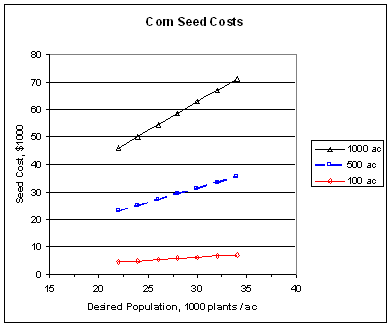 Table 1 illustrates an example comparing seed corn
costs for 26,000 and 30,000 plants per acre on 30-inch rows for four
different varieties on a 1000 acre farm. Note that the difference
between these populations is $8365 or $8.36 per acre for the seed lots
shown. Growers are encouraged to use this spreadsheet tool to help
record and control seed costs. It can be used to quickly calculate
seed costs for other scenarios with corn or soybean and is available
on the web at www.bae.uky.edu/ext/Grain_Storage/Calculators/. Table 1 illustrates an example comparing seed corn
costs for 26,000 and 30,000 plants per acre on 30-inch rows for four
different varieties on a 1000 acre farm. Note that the difference
between these populations is $8365 or $8.36 per acre for the seed lots
shown. Growers are encouraged to use this spreadsheet tool to help
record and control seed costs. It can be used to quickly calculate
seed costs for other scenarios with corn or soybean and is available
on the web at www.bae.uky.edu/ext/Grain_Storage/Calculators/.
Figure 1.
Typical
range in corn seed costs at different plant populations for 100, 500
and 1000 acre operations.
Table 1.
Illustration
of the calculator for comparing corn seed costs for two different
plant populations on 30-inch rows, based on seed tag/bag data (weight,
germination and purity) and cost per bag (80,000 kernel unit). The
number of acres for each variety is also entered to calculate the
total number of bags needed for each population and the total and
average seed cost. A calculation is also made for a drill or planter
calibration at both seeding rates (weight and number of seeds per acre
and weight of seed [grams] in a 200-ft strip).
|
Seed tag data |
|
|
Variety |
Lot
No. |
No.
Seeds per bag |
Weight per bag
lb |
Germ
% |
Purity
% |
Cost
per
bag |
No.
Acres |
|
Corn |
xx1 |
80,000 |
39.80 |
95 |
99.0 |
$
125.00 |
250 |
|
Corn |
xx2 |
80,000 |
41.23 |
85 |
99.0 |
$
150.00 |
250 |
|
Corn |
xx3 |
80,000 |
44.08 |
92 |
99.0 |
$
150.00 |
250 |
|
Corn |
xx4 |
80,000 |
49.30 |
95 |
99.0 |
$
180.00 |
250 |
|
|
|
|
|
|
|
Total |
1000 |
|
Desired stand
1000/ac |
Lot
No. |
gm /
200 ft
of row |
lbs
seed
/ acre |
actual
seeds
/ acre |
No.
bags |
Cost |
|
per
seed lot |
per
acre |
|
26 |
xx1 |
72 |
13.8 |
27,645 |
86 |
$ 10,799
|
$ 43.20 |
|
|
xx2 |
83 |
15.9 |
30,897 |
97 |
$ 14,483
|
$ 57.93 |
|
|
xx3 |
82 |
15.7 |
28,546 |
89 |
$ 13,381
|
$ 53.52 |
|
|
xx4 |
90 |
17.2 |
27,927 |
87 |
$ 15,709
|
$ 62.84 |
|
|
|
|
Total (and
average) |
359 |
$ 54,372
|
($ 54.37) |
|
Desired stand
1000/ac |
Lot
No. |
gm per
200 ft
of row |
lbs
seed
/ acre |
actual
seeds
/ acre |
No.
bags |
Cost |
|
per
seed lot |
per
acre |
|
30 |
xx1 |
83 |
15.9 |
31,898 |
100 |
$ 12,460
|
$ 49.84 |
|
|
xx2 |
96 |
18.4 |
35,651 |
111 |
$ 16,711
|
$ 66.84 |
|
|
xx3 |
94 |
18.1 |
32,938 |
103 |
$ 15,440
|
$ 61.76 |
|
|
xx4 |
103 |
19.9 |
32,223 |
101 |
$ 18,126
|
$ 72.50 |
|
|
|
|
Total (and
average) |
415 |
$ 62,737
|
($ 62.74) |
(return to top)
|
| |
|