|
|
Corn & Soybean News June,
2007, Volume 7, Issue 6 printer-friendly version (pdf) Cooperating
Departments: Agricultural Economics, Biosystems and Agricultural Engineering,
Entomology, Plant and Soil Sciences, Plant Pathology Editor:
|

|
In this
Issue:
4. Dry Weather and Nutrient Deficiencies
5. Can Fungicides Overcome Yield Penalty? |
|
|||||||||||||||||||||||||||||||||||||||||||||||||||||||||||||||||||||||||||||||||||||||||||||||||||||||||||||||||||||||||||
|
Did the Dry May Affect Yield in 2007?
D.B. Egli, Plant and
Soil Sciences
The 2007 cropping
season is off to a rough start. The unexpected heavy frosts in April that
wreaked havoc with our wheat crop were followed by an exceptionally dry May
with statewide rainfall (2.43 inches) about half of normal1. The
only drier May in the last 30 years was May of 2005 when only 2.33 inches of
rain fell. Is a dry May a bad omen for the future? Should we expect low corn
and soybean yields this fall?
Before this year,
there were six Mays in the weather records for the past 30 years (1978 –
2007) with average state rainfall of roughly 2 inches or more below normal.
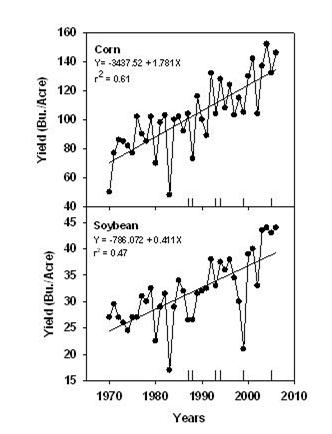
Soybean yields were above the trend line in two of the six years, essentially
on the line in one year, and below the line in the other three (Fig. 1). Corn
yields were below the trend line in three years, on the line in one year and
above it in two years. It seems that a dry May does not automatically spell
disaster in Kentucky. Fig. 1 clearly shows that good yields can follow a dry
May, which is not surprising since it is the rainfall during flowering, seed
set and seed filling that is the most important in determining yield. Both
corn and soybean can usually recover completely from stress during early
vegetative growth if enough leaf area is produced to provide complete ground
cover before flowering and there is adequate rainfall during the critical
periods.
Summer rainfall
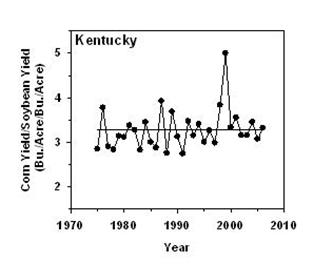
doesn’t always have the same affect on corn and soybean yield in Kentucky as
shown clearly by the variation in the ratio of corn and soybean yield
(calculated on a bushels/acre basis) (Fig. 2, also discussed in the February
2007 (Vol. 7, No.1) issue of the Corn & Soybean Science Newsletter). The
high ratio in 1999 reflects the exceptionally low soybean yield that year
while low ratios result from lower corn yields relative to soybean. The crop
that gets the rainfall during the critical periods is favored; some years
it’s soybean and some years it’s corn and some years there is no favorite
(ratio close to the mean). |
· Dry May is a poor indicator of final yields.
· There have been many dry Mays before Global Warming became an issue.
|
|||||||||||||||||||||||||||||||||||||||||||||||||||||||||||||||||||||||||||||||||||||||||||||||||||||||||||||||||||||||||||
|
|
|
|
||||||||||||||||||||||||||||||||||||||||||||||||||||||||||||||||||||||||||||||||||||||||||||||||||||||||||||||||||||||||||
|
|
Did global warming and
climate change contribute to our abnormal spring? Many climate models predict
that global warming will increase extreme weather events and cause changes in
precipitation patterns. It is impossible, however, to determine if global
warming was responsible for our disastrous weather this spring. What we do
know is that dry Mays have occurred before, in fact, many occurred long
before global warming was a topic of conversation. Statewide precipitation
records show that there were twelve Mays in the last 113 years (back to 1895)
when precipitation was less than half of normal. The record low was in 1932
(1.38 inches) and five years from 1930 to 1941 had less than 2 inches. We
don’t have to invoke global warming to explain this year's dry May, it
happened before, long before global warming was thought to be a force in
shaping our climate. Historical weather and
yield records suggest that a dry May is no reason to panic. We still have
about a 50% chance of good yields – it all depends on the rainfall in July
and August. Remember that in 2005, a single storm, the remains of Hurricane
Katrina, played a major role in producing excellent yields in Kentucky. The
difference between success and failure can hinge on a few rainfall events at
critical times, events that no one can forecast.
. . 1 The weather data and the analysis used
here were obtained from the website of the University of Kentucky Agriculture
Weather Center which can be accessed at http://wwwagwx.ca.uky.edu/
or through the College of Agriculture webpage (http://www.ca.uky.edu/).
|
|
||||||||||||||||||||||||||||||||||||||||||||||||||||||||||||||||||||||||||||||||||||||||||||||||||||||||||||||||||||||||||
|
Corn Development during Water Stress
Chad Lee and Jim
Herbek, Plant and Soil Sciences
Corn across Kentucky ranges in height from 10 inches to 6 feet as June
15, 2007. Shorter corn is probably close to V6 (six visible collars), while
taller corn is probably close to V15. Areas of the state are still in a water
deficit, Current drought conditions across Kentucky can be accessed at
http://drought.unl.edu/dm/DM_state.htm?KY,MW. Many producers are asking what impact continued dry weather will
have on corn yield.
By the V6 growth stage, tassel development and ear shoot development
have both started. Corn at V6 is still using relatively little water
(probably less than 0.1 inch per day in 90 degree temperatures) and is
relatively tolerant to dry weather.
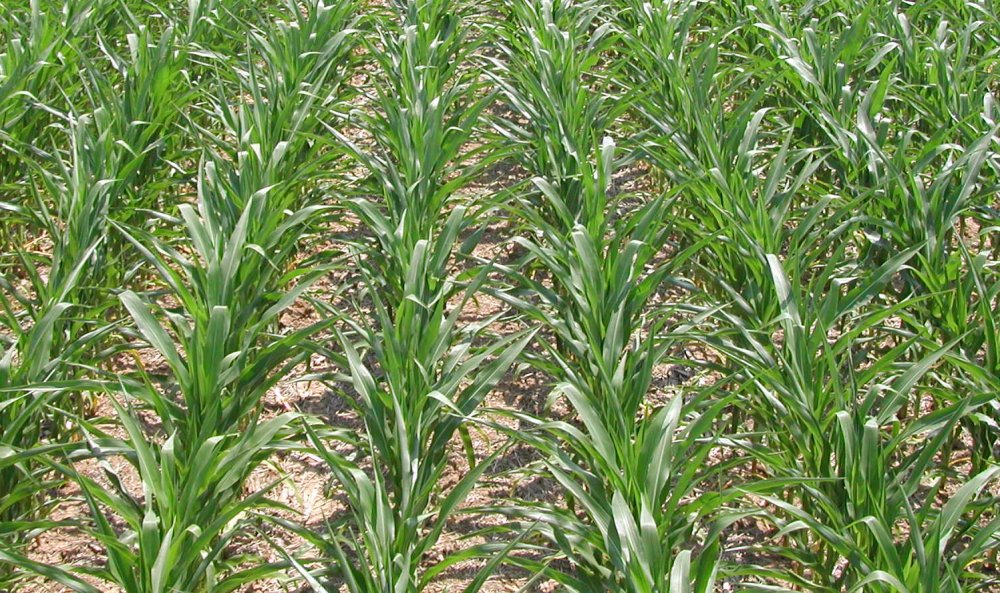
Corn with rolled leaves, indicative of water stress.
Once the corn reaches V6, the stalk will begin to grow rapidly. As
each new leaf is added to the plant, water demands will increase. When the
corn reaches V15, it is about 10 to 12 days from silking and is passing through the most critical stage for yield
determination. Dryweather from V15 through
pollination could reduce final ear size and kernel number. Even with the
current stress, a timely rain during pollination and seed fill could result
in good yields.
The bottom line is that corn needs rain, and we need it now. Corn that
is in earlier stages of development has more time and opportunity to produce
good yields. Corn that is close to tasseling still has a chance to make good
yields, but it needs rain now.
Resources:
Rosenburg,
N.J., B.L. Blad, and S. B. Verma. 1983. The Biological Environment, 2nd
Ed. John Wiley & Sons. New York. How a Corn Plant Develops, Special Report No. 48. Iowa State University. http://www.extension.iastate.edu/pages/hancock/
agriculture/corn/corn_develop/CornPlantStages.html
|
· Corn is relatively tolerant to dry weather at early growth stages.
· As leaf area increase, water demands increase. |
|||||||||||||||||||||||||||||||||||||||||||||||||||||||||||||||||||||||||||||||||||||||||||||||||||||||||||||||||||||||||||
|
Present Status of Soybean Crop
Jim Herbek and Chad
Lee, Plant and Soil Sciences
Approximately 80% of
the intended soybean acreage in Kentucky was planted as of early June. Most of the soybeans are still in
vegetative growth stages; ranging from V4 to V6 for early May plantings and
V1 to V3 for mid-late May plantings.
The lack of moisture in May has resulted in slower plant growth and
development. However, this should have
little, if any, effect on yield potential at these early vegetative growth
stages. If the moisture stress
continues to be prolonged, yield may be reduced because of less plant growth
(fewer nodes for pod development).
Unfavorable weather stress will have more of an impact on yield during
the reproductive stages of R3 to R4 (pod development) and R5 to R6 (seed
development) than vegetative stages.
The small acreage of soybeans planted in April are further along in development. These earlier planted soybeans have 6 to 7 vegetative nodes and are in the flowering process (R1 to R2) depending on the maturity group. Some flower abortion has occurred, but should have a negligible effect on yield, since some flower abortion occurs every year. The soybean plant is very resilient and can compensate within reason for brief stress periods as it continues plant development, unless the stress is prolonged.
|
· Soybeans in vegetative stages have time to recover from dry weather.
· Dry weather during seed filling is detrimental to yield.
|
|||||||||||||||||||||||||||||||||||||||||||||||||||||||||||||||||||||||||||||||||||||||||||||||||||||||||||||||||||||||||||
|
Common Nutrient
Deficiencies During Drought
Lloyd Murdock &
Greg Schwab, University of Kentucky
Nitrogen
Fertilizer N applied
to the soil surface requires water to move it to the root zone. Under drought
conditions, the soil surface will remain dry and the fertilizer N will not
move into the root zone or the corn plant. If the added fertilizer N is below
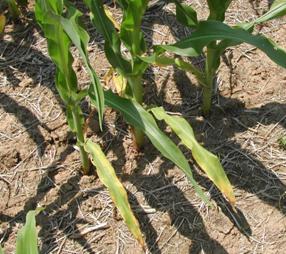
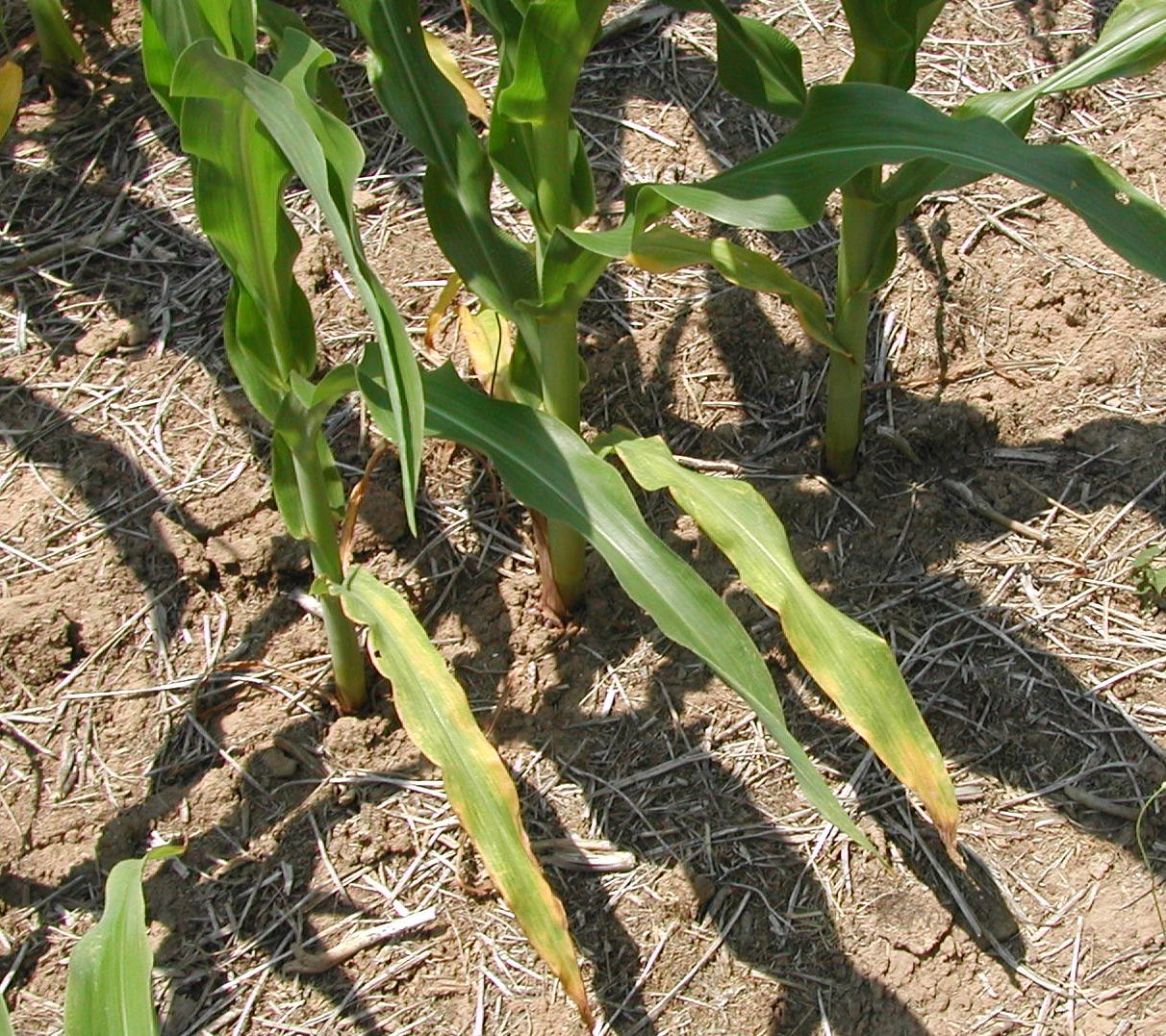
recommended levels, corn will begin to show the deficencies first. The lower leaves will begin to yellow at
the leaf tip and move towards the stalk.
The midrib section of the leaf will yellow first. When rain returns, the plant will begin to
take up N at a more rapid rate and the plant will recover.
If part of the nitrogen
was applied at or before planting, it will be located deeper in the profile
and N deficiencies will be slow to appear or will not appear. The best way to use sidedressed N is to
apply about 1/3 of the N preplant.
This helps prevent a temporary N deficiency during drought years.
If most or all the N
was sidedressed, it may be positionally unavailable during droughts. This is the biggest risk to sidedressing
N. The nitrogen on or near a very dry soil
surface causes the roots to have difficulty extending into that area or
removing N and water in large quantities from this area. A rain will correct this situation. Injecting the N helps place it in a better
environment for uptake. Also
no-tillage usually results in more moisture and more roots in the soil
surface which also helps some.
Nitrogen
Losses
The loss of N is
usually minimal during extended dry periods.
When N deficiencies become apparent during this time, many producers
think they may have lost a lot of the applied N but that is usually not the
case.
The main avenue of
loss when N is applied to dry soils is volatilization. The sources of N where this would be
prevalent are urea and liquid N (UAN).
Volatilization N losses are greater with surface applied N sidedressed
and no-tilled. Conditions that
increase volatilization are applications of urea and UAN to moist soils,
followed by dry and windy weather. If urea and UAN are applied to the surface
of dry soil less volatilization will occur. Due to the reduced N uptake
during a drought, high N losses are suspected. This is usually not the case.
Factors that reduce
volatilization losses are injection or streaming of UAN (injection is much
more effective) also rainfall or irrigation within 2 days after N
application, as well as urease inhibitors added to the N fertilizer.
Potassium
K is less available
under drought conditions. With our
tillage practices used today, most of the available K is in the surface 3 to
4 inches. There is K in the lower
parts of the profile but at a reduced level.
If the top few inches become severely dry then the uptake of K is severely
reduced and K deficiencies can occur.
Corn showing K deficiency.
K deficiencies during
dry weather usually occur when the K soil test levels are low and/or soil compaction
exists. Soils with proper levels of
soil test K will have more K available for the plant and will reduce chances
for a deficiency. During normal or
moist years, low soil test K levels are many times adequate due to better
conditions for uptake.
If K deficiencies
exist, check soil test levels in the field, especially in the K deficient
areas. Also, check for compaction in
these areas. The soil test for K
should be kept in the medium to high range or recommended levels of K
fertilizer need to be added. Adding K
fertilizer to K deficient fields can correct the deficiency but only if
sufficient rainfall occurs to move the K fertilizer into the soil. With adequate rains, the K fertilizer will
quickly dissolve and move into the soil for rapid uptake.
|
· N and K require water to move into plants.
· Dry weather can cause deficiencies, even if adequate fertilizer was applied. |
|||||||||||||||||||||||||||||||||||||||||||||||||||||||||||||||||||||||||||||||||||||||||||||||||||||||||||||||||||||||||||
|
Fungicides Did Not Make the Rotation Effect Go Away
John H. Grove, Plant
and Soil Sciences
In a previous
newsletter, the rotation effect, the yield reduction that occurs to corn
grown after corn, relative to corn grown after another crop, was shown to
increase as the general yield level rose (it gets worse as the season gets
better). Research done at the West Kentucky Research and Education Center,
near Princeton, has looked at a number of corn residue management techniques,
but none of these successfully increased corn after corn yield. There have
been a number of testimonial reports that plant diseases are more prevalent
in corn after corn. Two trials, on different soils, with different hybrids
and planting patterns, evaluated the benefit of a foliar fungicide
application at growth stage R2 (late silking) on both corn after corn and
corn after wheat/doublecrop soybean at the Kentucky Agricultural Experiment
Station farm near Lexington (Spindletop).
The first trial was on
a moderately eroded hillside (Maury silt loam), with Monsanto-DeKalb DKC61-45
planted 13 May in 36-inch rows. The at-harvest stand averaged 27,000
plants/acre. The corn after corn treatment was 23rd year continuous
corn in 2006. The second trial was on a summit landscape position (Loradale
silt loam), with Pioneer 33R76 planted 8 May in 30-inch rows. The at-harvest
stand averaged 28,100 plants/acre. The corn after corn treatment was 2nd
year continuous corn in 2006. Foliar disease pressure at the time of
fungicide (combination of Tilt and Folicure) application was low, in both
experiments. Yield results of the two experiments are given in Table 1,
below.
Table 1. Corn grain yield response to use of
fungicides on corn in two crop rotations in two different field experiments.
Rotation was generally
beneficial (average of +21 bu/acre), regardless of whether fungicide was
used. There was no benefit to the use of fungicide (average of -0.25
bu/acre), regardless of rotation. There was no fungicide by rotation
interaction, so use of these fungicides was not of greater benefit to corn
after corn than to corn after wheat/soybean. This represents only one year of
information, but the data suggest that the rotation effect was quite
significant (about 10% of yield potential), despite low foliar disease
pressure and use of hybrids with good foliar disease resistance. Use of
fungicides, in the absence of foliar disease, did nothing to alleviate the
rotation effect.
|
· The rotation effect had more impact on yields than fungicides. · Fungicides in the absence of disease pressure did not improve yields. |
|||||||||||||||||||||||||||||||||||||||||||||||||||||||||||||||||||||||||||||||||||||||||||||||||||||||||||||||||||||||||||
|
Corn
Hail Damage
Chad Lee, Plant and
Soil Sciences
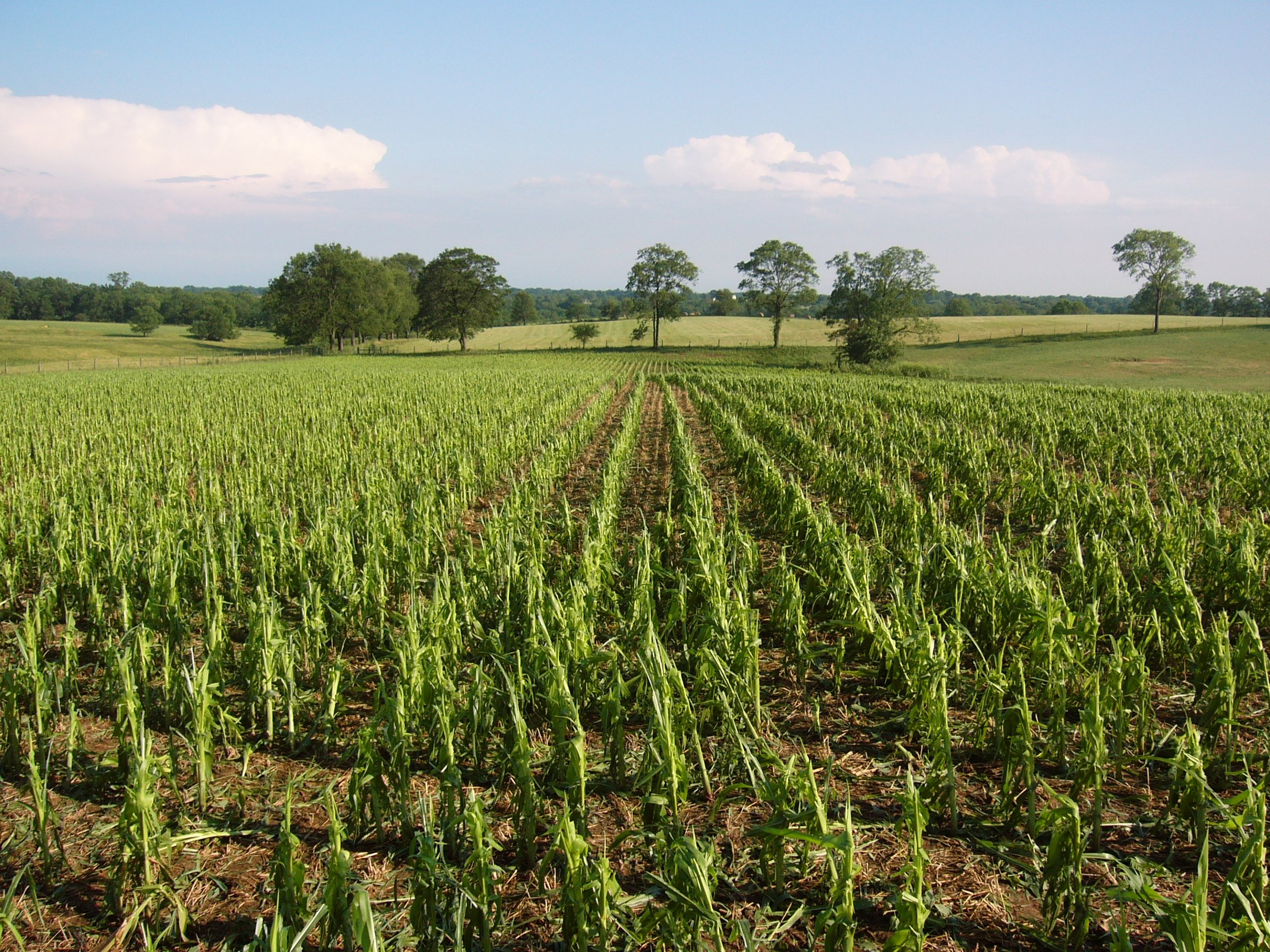
Isolated hail storms hit
areas of central and eastern Kentucky on June 5, 2007. While phone calls and
field visits have addressed the concerns of most of those fields, we decided
to
include a refresher
issue
on
assessing hail damage. The extent of
damage depends on the growth stage, leaf area destroyed and surviving stand.
Growth Stage
The growing point
usually begins to move above ground as corn approaches the 8-leaf stage (8
leaves drooping) which is usually equivalent to V6 growth stage (six visible
collars). Corn is highly tolerant to hail damage at these early stages of
growth. As the growing point moves above ground and the corn plant gets
closer to tasseling, it becomes more susceptible to hail damage. Corn is most
susceptible to hail damage just prior to tasseling through early milk. Once
corn passes through the early milk stage, it becomes more tolerant to hail
damage.
Percent Leaf Area
Destroyed
Estimate the amount of
leaf material that is missing or no longer green. Any green leaf material,
even that which is shredded, should not be counted as destroyed. The
following table is adapted from the National Crop Insurance Association’s
“Corn Loss Instructions” (Rev. 1984). The entire Table can be found in a
Nebraska Extension publication (Vorst, 1986). The 8-leaf stage as determined
by a hail adjuster is usually equal to a V6 leaf stage (six collars visible).
The numbers in Table 1 assume that the corn stand was not reduced by hail.
Estimating Stand
Reductions in corn
stand may reduce yields. For most of Kentucky, stands ranging from 22,000 to
30,000 plants/acre are ideal. Stands below 22,000 plants/acre will cause
yield reductions. At this time, replanting corn would
result yield losses of at least 30%.
Tied Whorls and
Silking
Corn plants damaged by
hail early in the season usually recover from tied whorls and bruised stalks.
The corn will usually grow through these tied whorls within 3 or 4 weeks
(Mangen and Thomison, 2000). Stalk bruising had little impact on lodging. If
bruising occurs directly on the growing point of the corn plant, then the
corn plant may not survive. Silking will be delayed on severely damaged corn
plants. Corn from V5 through V7 that received 100% leaf loss had a 1 to 1.5
week delay in silking compared with plants that received 80 to 90% leaf loss.
Looks Worse than It Is
Hail damage early in
the growing season almost always looks worse than it really is. Wait about
five days before making any kind of stand assessment. If replanting does
become necessary, then switch to an earlier hybrid.
References:
Vorst,
J. J. 1986. Assessing Hail Damage to Corn, G86-803-A:
http://ianrupus.unl.edu/fieldcrops/g803.htm
Mangen,
T. and P. Thomison, 2002. Early season hail damage in corn: effects of stalk
bruising and tied whorls. Agronomic Crops Team On-Farm Research Projects
2000. Special Circular 179-01.
http://ohioline.osu.edu/sc179/sc179_16.html
|
· Hail damage on young corn normally will hurt yields very little. · Replanting corn now will result in at least 30% yield losses. |
|||||||||||||||||||||||||||||||||||||||||||||||||||||||||||||||||||||||||||||||||||||||||||||||||||||||||||||||||||||||||||