Herbicide carryover in corn and soybean rotations is generally not a major concern in Kentucky compared with certain regions in the Midwest; however, the risks of carryover may be greater this season because of the last year's dry weather. Discussed below are examples where potential carryover problems may occur.
1. Atrazine and Princep: There have been a few instances where atrazine and or Princep is believed to have injured wheat last fall, but fortunately these cases have been isolated. The fact that most of the atrazine and Princep applications were applied early and received some rain in the1999 season probably helped in the dissipation of these herbicides. If atrazine was applied after June10 last year (for example some post applications may have been applied to late planted corn) only corn or sorghum should be planted this season. UK herbicide recommendations do not promote a rotation of tobacco following atrazine or Princep. However, if farmers intend to grow tobacco in suspect fields, a triazine soil test may be of some help in predicting the risk of injury.
2. Canopy: Soils with a pH > 7.0 will be prone to causing injury to corn from the active ingredient chlorimuron. Planting an imidazolinone- resistant corn (i.e. Clearfield hybrids) and allowing a 10-month rotation interval is recommended where soil pH is between 7.0 and 7.5.
3. Exceed and Spirit: Use only soybean cultivars with STS genetics if rainfall was less than 12 inches during the first 5 months following application and /or less than 1 inch within the first 4 weeks after application of Exceed or Spirit in 1999. Fields treated with Exceed or Spirit last season should not be rotated to soybeans this year where soil pH > 7.8
4. Scepter, Squadron, and Steel: Do not rotate to corn this year unless using an imidazolinone-resistant tolerant/resistant (Clearfield) hybrid when less than 15 inches of rainfall occurred from two weeks prior to soil application through November 15 last season.
5. Command: Corn injury from carryover of Command has not been a widespread problem in Kentucky; however, the risks may be greater where soil pH is less than 5.9 or where conditions were extremely dry during 4 months following application.
KENTUCKY BLUE MOLD WARNING SYSTEM: With the above report, we start another season and the third decade for the Kentucky Blue Mold Warning System. This is an advisory program designed to help Kentucky's tobacco industry deal with a very destructive and explosive disease - tobacco blue mold. Epidemics since 1995 have cost Kentucky's tobacco growers more than $300,000,000 in losses at the farm! Blue mold is a very weather- sensitive disease that spreads via airborne and transplant-borne means. It can overwinter in Kentucky when infected, live tobacco survives. Although the disease is best known for the leaf spot phase, it can damage the crop in all phases of production, but it is especially serious in transplant production and when it goes systemic in field plantings.
Kentucky experiences tobacco blue mold nearly every season , because many factors come together here in a timely manner. At the same time, it is rare that all regions of the state face similar threats at the same time. Burley tobacco in general is highly susceptible and modern production methods often favor blue mold development. Dark tobaccos are less susceptible, but they too can be damaged , especially while young. Kentucky's moderate weather is often highly conducive to blue mold development and many of the systems are harboring spores of the pathogen from nearby as well as other areas. Kentucky 's tobacco is particularly vulnerable when wet weather systems stagnate in the state. But, in most seasons when there is not extended drought, there is sufficient moisture to provide wet foliage many nights when temperatures are dropping into the mid 60's - nearly ideal for disease development. Much of our production is in foggy areas , a key factor in blue mold development, and more of it is moving into such sites..
Keys to blue mold control include using blue mold-free transplants, avoiding disease-conducive environments, reducing the plant's susceptibility to blue mold, and timely fungicide applications. The warning system can help growers in making timely decisions.
The Kentucky Blue Mold Warning System has operated since 1980 with status reports and coordination from the Plant Pathology Department, College of Agriculture, University of Kentucky. Kentucky's system incorporates and serves in a cooperative network with local and national blue mold advisory and control efforts. Locally, it is connected directly to the County Extension Agents for Agriculture and Kentucky Pest News. Nationally, it cooperates closely with the North American Blue Mold Warning and Forecast System, headquartered at North Carolina State University, a cooperative network of state blue mold coordinators, plant pathologists, and meteorologists. The national forecasts and reports are of great value to Kentucky, especially to the plant pathologists. We are appreciative of all these efforts, because they serve as critical resources and input during the development of local advisories and control suggestions. However, we urge the regular following of the Kentucky Blue Mold Warning System for guidelines related to the Kentucky situation.
Regular reports from the warning system will appear in
Kentucky Pest News under the heading "Current Blue
Mold Status". In addition, this information is available
on the Internet at
 www/uky.edu/Agriculture/kpn/kyblue/kyblue.htm.
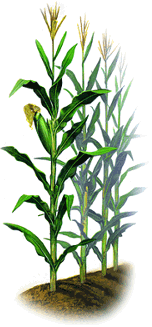
Italian ryegrass is a cool-season annual that is difficult to control in no-till corn. Sequential applications of "burndown" herbicides tend to be more successful in managing Italian ryegrass than a single spray. This approach includes the use of Gramoxone Extra at 1.5 pt/A, or Roundup Ultra at 2 pt/A, or Touchdown 5 at 1.6 pt/A as an early preplant treatment followed 5 to 10 days later with Gramoxone Extra at 1.5 pt/A. Soil- residual herbicides for managing other weeds can be included applied with the second burndown treatment.
There may be instances where corn has been planted and the initial "burndown" treatment was not applied. The use of Roundup Ultra at 3 pt/A or Touchdown at 2.4 pt/a as the "burndown" treatment may aid in controlling Italian ryegrass where a sequential burndown program is not possible.
Once corn has emerged, the opportunity to control Italian ryegrass becomes very limited. A postemergence application of Accent may limit regrowth, however, growers should not expect complete control of Italian ryegrass plants. The success of Accent will likely depend on how much regrowth has occurred since the burndown was applied. Plants with well developed crown tissue are likely to have more regrowth and be more difficult to control compared with plants with just a few tillers emerging from the crown.
The use of Lightning in Clearfield corn hybrids is an option that is being investigated for managing Italian ryegrass regrowth after corn emergence. Timing the Lightning treatment to achieve optimum control of Italian ryegrass as well as late emerging weeds such as johnsongrass is management decision that a grower must consider with this approach.
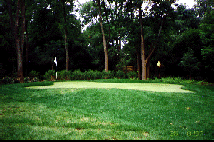
Several species of wild bees nest below ground and fall into the general category of "yard bees". One group, the plasterer bees were active in home lawns over the last week. These colletid bees resemble honey bees but are dark bodied with bands of white across the abdomen. Honey bees typically swarm later in the spring and generally hang on trees or bushes rather than on the ground.
Plasterer bees are solitary, which means that each constructs an individual burrow with side branches and chambers. The burrow walls are lined with a thin, relatively clear substance. Thus the name plasterer bee. Communities (dozens to hundreds) of them may build up in a favorable section of turf over time. If necessary, control approaches discussed in Entfact 411, Yard wasps, can be used.
By John Hartman
There are many landscape maintenance activities occurring in the spring which can affect the health of trees and shrubs in the landscape. Landscapers and homeowners can learn to use a holistic maintenance approach such as Integrated Pest Management (IPM) or Plant Health Care to avoid potential disease problems. By working out in advance the potential consequences of poor plant maintenance practices, landscape plant health and longevity can be enhanced. The following are timely and helpful suggestions for enhancing the health of landscape plants.
Choose the right location for plants in the landscape. Too often, perfectly good plants are located in sites that favor disease outbreaks. An important IPM concept is to choose plants that will grow well in a particular landscape site, or to modify the site so that the plants will grow at their best. Plants that must struggle to overcome the effects of a poor growing location are usually the most vulnerable to diseases.
For example, Rhododendrons and azaleas require well- drained acid soil. If the soil is poorly drained, they are vulnerable to Phytophthora root rot, and if the soil is too sweet, they will turn yellow. If the landscape bed is not naturally suitable, one needs to create well-drained beds with acid soil for them. The same is true for white pines. They can grow well in some Kentucky locations, but they, too need acid and sandy soil. If the roots are not provided with these good conditions, expect white pine decline to gradually take out the trees.
If landscape plants such as crabapples, dogwoods, roses, and other plants prone to leaf diseases are planted in shady locations or if they are planted so densely that good air movement and ventilation are not possible, the planting site has been poorly selected. In such cases, one should expect outbreaks of diseases such as scab, black spot or powdery mildew when susceptible cultivars are planted to shady sites.
Choose disease-resistant plants for the landscape. Where it is available, disease resistance is a most efficient means of plant disease control. When it comes to fighting diseases of landscape plants, it sometimes pays to know the name of the cultivar and how it is likely to respond to diseases that are common here.
For example, flowering crabapple is a popular small tree for residential landscapes. With flowers, foliage and fruit, it can be attractive in all seasons, especially during bloom. Unfortunately, it can be detrimental to the beauty of the landscape when it is diseased. Flowering crabapple can be plagued with scab, fire blight, cedar-apple rust, and powdery mildew. These diseases can cause spotted, wilted leaves, rotted fruit, and premature leaf fall. These diseases can be avoided by planting cultivars that are disease-resistant. Disease- resistant flowering crabapples such as 'Prairiefire', 'Mary Potter', and 'Harvest Gold' have been developed and are on the market; lists are available at the local Cooperative Extension Office.
There are other tree and shrub diseases for which disease resistant types are available. For example, there are elm cultivars resistant to Dutch elm disease, roses resistant to black spot, rhododendrons resistant to Phytophthora wilt, tip blight resistant junipers, rust resistant hawthorns, fire blight resistant cotoneasters, and the list goes on. To obtain and plant a disease- resistant type requires knowing the name of the cultivar and buying it from a reliable nursery. In addition, there are lists of tree and shrub species (not just cultivars) that are not susceptible to Verticillium wilt or crown gall. Incorporating disease resistance into the garden is good integrated pest management strategy.
How a tree or shrub is planted often affects its health. When trees and shrubs decline in the landscape, the cause is often thought to be one of the pathogenic fungi or bacteria seen growing in branch and twig cankers. But when one of these pathogens is observed, is it necessarily the cause of the plant's demise? This opens up many questions for the diagnostician. Did the tree decline due to lack of space for the roots to grow? Was the planting hole properly dug to be much wider than the size of the root ball? At planting, it is best to use the same soil that came out of the hole to backfill around the root ball. Was the soil that was put back into the hole the same as the original soil dug out? Did root rot occur because the planting hole was poorly drained?
Did anyone observe girdling at the base of the tree? The strangling effect of girdling roots or twine would stress the tree and invite opportunistic pathogens. If the tree or shrub was removed from the container, were encircling roots detected? Were they cut or removed before planting? What about the twine at the base of the trunk used to hold the burlap wrap in place? Was it removed and was the burlap peeled back from the top and sides of the root ball at planting? Did anyone notice that the twine was plastic? If left in place, the plant would soon be strangled.
Trees often decline because the tree was planted too deep. When the tree was planted, were flaring buttress roots at the base of the trunk observed? Was the soil from the nursery brushed back to expose the buttress root flare at the top of the root ball? Was the tree set so deep that the root flare was covered? Newly planted trees and shrubs, with their recent root pruning, are certainly growing under drought conditions. Many canker-causing fungi develop only when plants are drought stressed. What caused the drought? Was the root ball kept moist before planting? Was the area over the root ball watered frequently after planting? Was mulch used around the base of the tree to keep the root ball moist? The answers to these kinds of questions illustrate the importance of using good planting techniques to avoid tree and shrub diseases.
Thus, to maintain long-term tree and shrub health in the landscape, make good decisions now. Choose the right location for new plants in the landscape, choose disease-resistant plants, and plant trees and shrubs properly in order to start them off right and to assure that they will have good health for a long time.

Beginning in 1996, the Environmental Protection
Agency (EPA) started visiting with individual
consumers to learn what they thought about existing
labels on a variety of pesticide products and in the
process, solicited ideas about label problems and
potential solutions. Over 1997 and 1998, many
companies that make these consumer products got
involved in making label information more
understandable and useful. Research was done to help
make the language on pesticide product labels simpler
and more direct, and the format of labels easier to
follow. In the Spring of 2000, EPA and organizations
involved in the CLI will be initiating a national
campaign to encourage consumers to "Read the Label
FIRST!" The goal of the campaign will be to get people
to focus on and understand the health, safety, and
environmental information available on labels. The
campaign will also help people to understand the ways
in which labels will be changing as a result of the CLI
project. For more information concerning the CLI
project, visit their website at:
http://www.epa.gov/oppt/labeling/ .
Kap Dong Kim, owner of a ginger root farm in Hilo,
Hawaii, was sentenced to four months in prison and a
$5,000 fine and was ordered to pay $6,113 in restitution
on Jan. 24, in U.S. District Court in Honolulu. Kim
previously pleaded guilty to illegally using the
restricted use the pesticide nemacur on his ginger root
crop in violation of the Federal Pesticide, Fungicide and
Rodenticide Act. Kim directed workers to apply it on
the crop without following required standards for
worker protection. One worker was poisoned and had
to be hospitalized. Kim then deliberately failed to
disclose the pesticide application when questioned by a
government official. Civil charges against Kim are also
pending. This case was investigated by EPA's Criminal
Investigation Division, the Hawaii Department of
Agriculture with the assistance of EPA's National
Enforcement Investigations Center, and was prosecuted
by the U.S. Department of Justice.
(EPA Press Advisory 2/3/00)
Lynne Harrison pleaded guilty to a charge that she violated a provision of the Federal Insecticide, Fungicide, and Rodenticide Act (FIFRA) by using the pesticide DEET (insect repellent) on human test subjects without their being fully informed of the nature and purpose of the tests and of any reasonably foreseeable physical or mental health consequences. Harrison admitted that in 1995 and 1996, her company tested products containing DEET on at least 300 unsuspecting test subjects. Harrison Research Laboratories Inc. of which Harrison is president and majority owner, also pleaded guilty to obstruction of justice in connection with an inspection being conducted by the EPA. Harrison admitted that upon notification of an EPA audit, her company asked the firm that contracted for the tests to backdate documents to help comply with regulatory requirements. Harrison faces a maximum sentence of 30 days in prison and a $1000 fine. The company faces a maximum fine of up to $500,000. (EPA Pesticide Program Update 2/11/00)
The Environmental Protection Agency's (EPA) regional
office in Atlanta, Georgia is involved in projects which
promote wider acceptance and implementation of IPM
in schools. The EPA worked in partnership with the
Florida Department of Agriculture and Consumer
Services and the University of Florida to develop a
World Wide Web site dedicated to "IPM in Schools"
information. The Web Site is nationally recognized as
an excellent resource for school IPM-related
information, and a list server is maintained for
individuals to exchange information on school IPM via
email. The Web Site address is:
http://www.ifas.ufl.edu/~schoolipm/ .
(EPA Alphabet Soup, Feb.2000)
| UKREC-Princeton, KY, March 17 - 24 | |
| Black Cutworm | 9 |
Details are posted on the Pesticide Applicator Training Web Site
http://www.uky.edu/Agriculture/PAT/welcome.htm

Several new Entfact publications are available. They can be found on the UK Entomology web page http://www.uky.edu/Agriculture/Entomology/enthp.htm. They are in both HTML and PDF format for use at county extension offices. These were issued during the summer and fall of 1999.
Entfact 127 Alfalfa weevil field sampling program
Entfact 128 Bt-corn refuges
Entfact 129 Lesser cornstalk borer
Entfact 130 Bt Corn: What it Is and How it Works
Entfact 216 Leafrollers
Entfact 218 Apple Bagging: Alternative Pest Management for Hobbyists
Entfact 315 Cabbage Webworm
Entfact 441 Insecticides for Control of White Grubs in Turf Grass
Entfact 442 Velvet Ants
Entfact 507 Lesser Mealworms and Litter Beetles
Entfact 508 Walk Through Fly Trap for Pastured Cattle
Entfact 509 Horn Flies and Cattle
Entfact 510 Face Flies and Pinkeye
Entfact 511 Horse Flies and Deer Flies
Entfact 642 Do-it-yourslef Termite Baits: Do They Work?
Entfact 643 Limitation of Home Insect Foggers ("Bug Bombs")
Entfact 644 Consumer Update: Termite baits
Entfact 645 Millipedes
Entfact 646 House Dust Mite
<
Lee Townsend
Extension Entomologist
