Archived Material Notice
The Kentucky Geological Survey has archived this material, meaning (1) it is for reference, research, or recordkeeping; (2) it was created before April 24, 2026;
(3) and the material has not been changed or altered since being archived. Please refer to our KGS Accessibility page for more information.
KGS Home >
Earth Science Education
Geologic and Paleontologic Cook Book
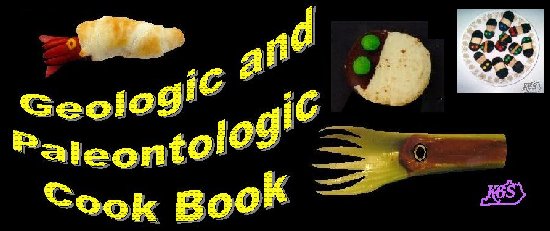
Would you like to make edible prehistoric critters?
Do you want to explore and mine for edible ores?
Would you like to make science fun and tasty?
Maybe you just want to start people talking about your next appetizer tray?
Then this is the site for you. The following are some edible suggestions. Some were concocted by our own resident paleontologists and scientists, others are links to sites elsewhere on the web. If you know of links to other recipes, or want to submit a recipe yourself, please contact Stephen F. Greb at the Kentucky Geological Survey. The only guidelines are that the activity, model, or exercise, should use food to illustrate, demonstrate, or explain an earth-science concept, and that the activity, model, or exercise can be safely eaten (at least in part) when finished.
-
Plate tectonics with an orange
Adapted from Women in Mining
Kentucky Coal Council, coal education web site
Here's a fun and healthy way to demonstrate plate tectonics to a K-12 audience. Students peel an orange to make plates in the earth's (orange's) crust.
- A paste with taste
Adapted from Women in Mining
Kentucky Coal Council, coal education web site
Would you like to make your own toothpaste? Would you like to experiment with different flavors? Then this is the experiment for you. Students try to produce a "marketable" product used by most people every day, that is made from minerals.
- Layer-cake geology
John R. Wagner
Department of Earth Sciences, Clemson University
This activity is aimed at grades 4-6 and helps students to visualize (1) mechanisms of folding and faulting, (2) the difference between brittle and ductile rocks, and (3) how core samples are used to predict the layering of rocks beneath the surface, by using a layer cake.
- Layer-cake mining
Adapted from Women in Mining
Kentucky Coal Council, coal education web site
In this exercise, a layer cake is used to show how folding and faulting effects rock strata and allows students to core into the cake strata to discover what's hidden beneath the surface
- Cupcake core sampling
Adapted from Women in Mining
Kentucky Coal Council, coal education web site
In this exercise, students use straws to core into cupcakes and see what's beneath the surface. They may record their findings and make a cross section of the cupcake's interior to see where the bed is that they should mine or eat.
- Paleo cookie dig
Sharon K. Heindel
Learning from the Fossil Record, University of California, Berkeley
In this activity, students use cookie bars, Rice-Krispie treats ®, and soil (the non-edible part of the activity) to dig for "fossils." Students plot the data collected and then make bar charts of their results, as would be done in an actual paleontological dig. Of course, students can then eat their data, which is rarely possible in actual paleontological digs.
- Mining in a nutshell
Adapted from Women in Mining
Kentucky Coal Council, coal education web site
This activity uses peanuts to demonstrate the steps that are taken to find, extract, process and use mineral resources. The students will be able to describe the major steps that a company must follow from initial discovery of a mineral deposit through consumption of a finished mineral product. The students will also be able to formulate ideas on ways to use waste products generated during mineral processing.
- Determining the age of rocks and fossils (with M and M's)
Frank K. McKinney
University of California, Berkeley
This 9-12-grade activity introduces students to age dating with exercises using relative and absolute dating. The idea of radioactive decay and half lives, a type of absolute dating, is shown through an activity using M&M's candy and graph paper.
Back to Classroom Activities
