
The Kentucky Geological Survey has archived this material, meaning (1) it is for reference, research, or recordkeeping; (2) it was created before April 24, 2026; (3) and the material has not been changed or altered since being archived. Please refer to our KGS Accessibility page for more information.
KGS Home > Geologic Hazards
Central U.S. Seismic Observatory (CUSSO)
A combination of strong-motion accelerometers and medium-period seismometers are currently installed at varying depths within the 1,950-foot (594 meter) borehole comprising the Central U.S. Seismic Observatory (CUSSO) in Fulton County, KY (see location map). The borehole penetrated the entire soil/sediment overburden (586 m) and was terminated 8 meters into limestone bedrock. Prior to casing the hole, electrical, sonic velocity (P- and S-wave) and deviation logs were acquired. Other site characterizations have also been conducted at CUSSO. The installation of strong-motion accelerometers at CUSSO will give us the ability to measure strong-motions from the bedrock through the soil column to the surface and measure how the soil column changes the characteristics of strong motions as they propagate to the ground surface. The installation of medium period seismometers, (0.06 - 50 Hz) at CUSSO will also provide real records for studying the effect by the sediments on seismic wave propagation. CUSSO will be a tool for evaluation of current analytical models for deep soil sites. Several analytical models are currently being used to predict the seismic response of deep soil sites; however, these analytical procedures have not been validated for sites deeper than 100 m (i.e., design engineers cannot be confident in their predictions). Earthquakes are now being recorded by CUSSO and data from these earthquakes are being analyzed. CUSSO is the only seismic station in the region with the ability to record bedrock ground-motions, soil column ground-motions, and free-field ground-motions from a site with >100m thick soil/sediment deposits. CUSSO, in combination with other instrumentations of the Kentucky Seismic and Strong-motion Network, as well as other networks in the region, will provide a better constrain on seismic hazard and risk assessments in the central United States.
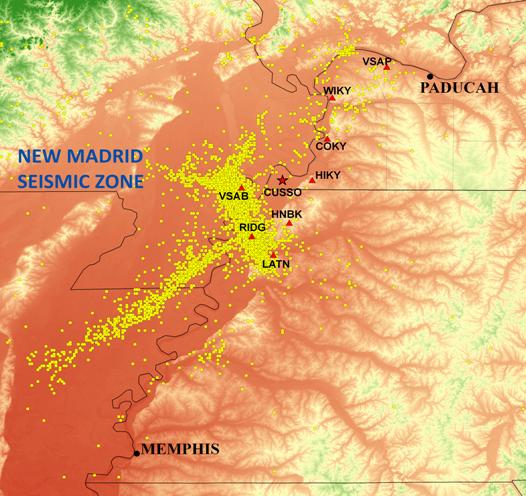
New Madrid Seismic Zone and the Central U.S. Seismic Observatory (CUSSO)
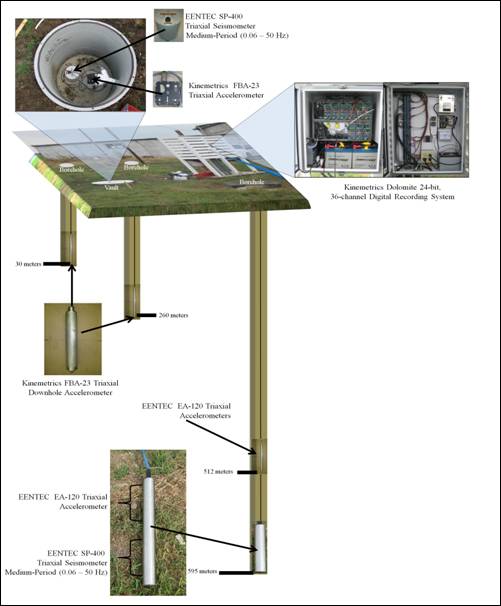
CUSSO instrumentation