PROJECT Part 1
Find a conservation problem or concern occurring in the 'Global South'. This project requires that you determine a precise location for this problem -- even though it may be widespread. For example, if you want to examine rhino poaching, your project would address rhino poaching in a particular game reserve or park in a particular country. For another example, if the problem is electronic waste, then you will need to tell us where the dump is located. Using google earth or google maps you should be able to find a suitable location.
Your TA or the professor will provide advice and assistance.
Pg 1
1. Title: Place, People, YOUR NAME,
Date, Section,
Geographical Coordinates of project site
People,
environmental issue or concern
2. Locator Map (Good source: UT Map Library): WITH COORDINATES PINPOINTED ON MAP
REMEMBER, THIS MUST BE A LOCATION IN THE GLOBAL SOUTH--any other options MUST BE APPROVED BY YOUR TA
When you pick a place, remember that this place must be no larger than a few square kilometers of rural space or an urban neighborhood. Your map must pinpoint this spot
Pg 2
Environmental Issue examined by your project: Imagine that you are writing an article or making a video on this struggle: tell us the basics -- Who, What, Where, When, How, Why?
1. What is the environmental issue or problem? specify the mechanism or manner in which the environment is affected (e.g., fauna or flora, persons, workers health). For instance, if toxicity, how does the toxin operate? if degradation (e.g., logging, habitat destruction), how is the environment degraded in its ability to sustain life or biodiversity reduced?
2. Estimate the magnitude of the environmental problem: (really big problems aren't worth more than local problems, so you don't need to choose a problem based upon its magnitude!)
a. Global Magnitude: in terms of areal extent, rate of destruction, numbers of people affected, number of animals slaughtered, etc. How big a problem is this? Does it affect a very wide zone and/or many people, or is limited to a relatively small area, affecting relatively few persons? Waste (be specific, e-waste, sewer sludge, medical waste)? how much waste? habitat destruction? how much deforestation? shark killings, how many?
b. Local Magnitude: How much does your selected problem affect your specific area? For example, e-waste is a global problem, but tell us how much you think is dumped in your selected location?
3. Environmental Conflicts and Environmental Justice (or environmental racism). Are there elements of environmental injustice, either local or international, associated with your environmental issue? Explain
Pg 3
Ethnographic Description: identify the group or people involved in the environmental conflict, and find a scholarly article on some aspect of their lives. Write about their lives using your ethnographic sources.
Good sources may be found by using a UK Library Search Engine such as:
Web of Science
Anthropology Plus
Rural: They may be either a people such as a tribe living in a specific village that you've identified or a class of folk such as farmers, peasants, wage earners, etc.
Urban: In the case of a city, they may be inhabitants of a particular neighborhood that you’ve identified or they may be a sub-group of interest such as homeless children, poor women, wealthy traders, small shopkeepers etc. Try to be as specific as possible and use the sources that you have uncovered to provide an overview of how they live, how they earn an income or obtain resources (e.g. through farming) and what key issues or problems they may confront.
Pg. 4
Analyze THE FOLLOWING TABLES using Databases in the Human Development Report
Write a paragraph in which you DISCUSS THE DATA FROM ONE OF THE FOLLOWING TABLES and EXPLAIN HOW you think that the people that you focus on RELATE to this statistic. The object of this analysis is to think about how to apply statistics, typically gathered on a national scale, to a specific group.Human Development Report Tables:
1. Table 5: Poverty LIne
Where do you think the study area people fit – the lowest quintile? somewhere in the middle? What is the per capita income, and how much do you think that your study people earn?
Or: are they below the poverty line, or do they earn less than $1.25 per day?
What does this mean in terms of their buying power? Do you think that your group participates much in the national economy?
How might income affect their ability to address environmental injustice or problems?
2. Table 4: Gender-related Development Index, answer the following questions:
How do the lives of men and women differ (e.g., access to schooling, income, hours working), and how might this affect the environmental conflict or people's ability to deal with the environmental problem? How might the problem differently affect people as a consequence of their gender?
Bibliography
- Aside from the tables, you will probley need two sources, one for the physical geography and built environment, and another for the ethnographic analysis.
- AT LEAST ONE SOURCE MUST BE FROM A SCHOLARLY SOURCE such as peer-reviewed journals or books (For instance, Wikipedia IS NOT a vetted source since the process through which information is added is not necessarily reviewed and corrected, although the bibliography at the bottom of the wikipedia page may be) PLEASE ASK YOUR TA IF YOU HAVE QUESTIONS).
Part II: environmental issue and Multi-Prong Policy Response.
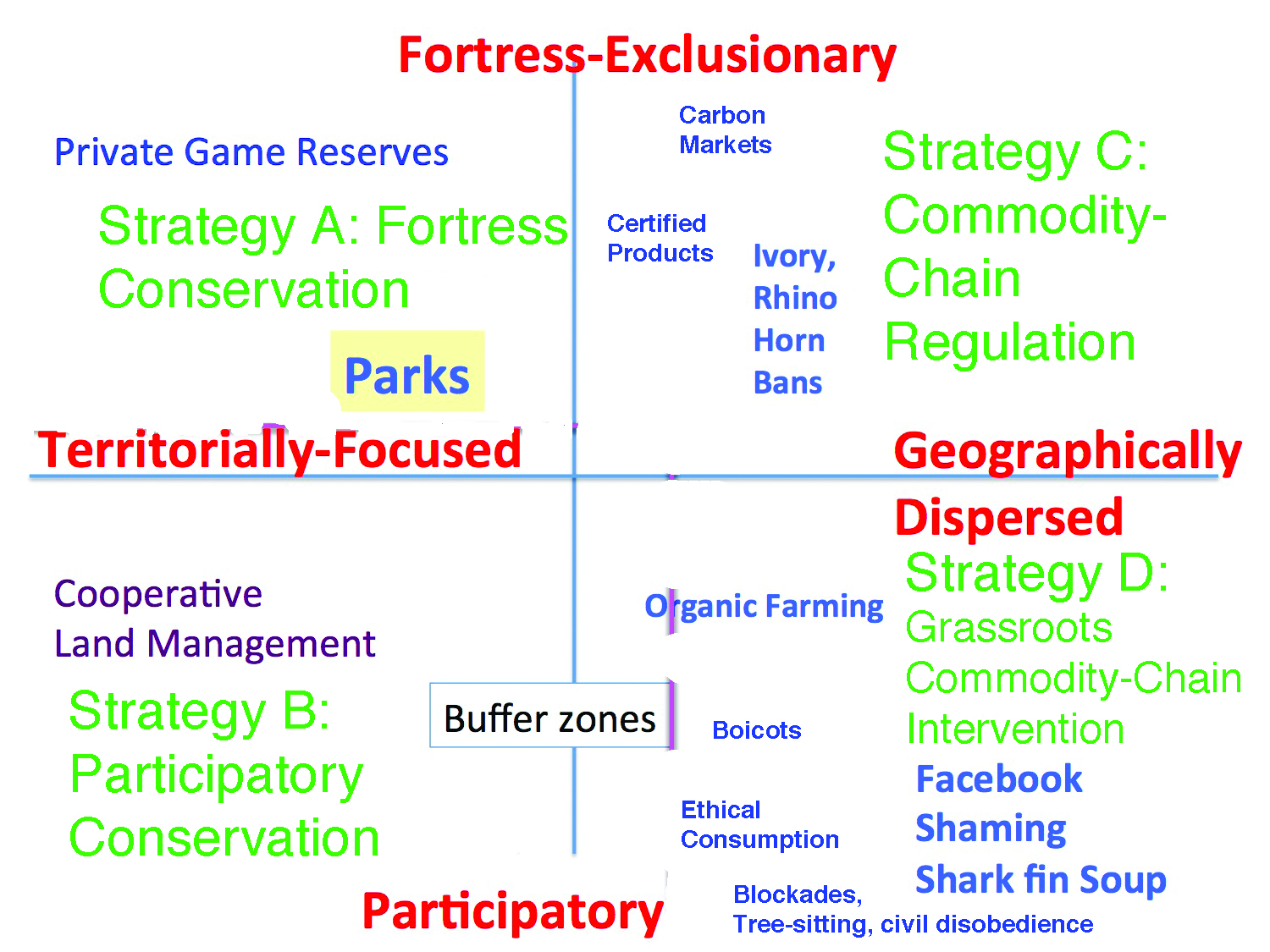
Strategies: Choose TWO strategies, drawn from TWO DIFFERENT AREAS from the Diagram below (as discussed in class). Describe your strategies in detail and explain how they will function to resolve or meliorate your environmental issue.
Design a Multi-Prong Using TWO of the FOUR approaches DESCRIBED IN CLASS (i. Exclusionary Territorial, ii. Exclusionary non-Territorial, iii. Participatory Territorial, iv. Participatory Non-Territorial)
Title Page: Place, People, YOUR NAME,
Date, Section,
Geographical Coordinates of project site
environmental issue or concern
Locator Map (Good source: UT Map Library): WITH COORDINATES PINPOINTED ON MAP
Environmental Issue or Concern: This Page will be the same as in Project Part 1, unless you have made other arrangements with your TA or are responding to the TA's critique of your first project. If you are responding to a critique, please talk with your TA before handing in Part 2 and be specific regarding your changes and corrections.
Page 2-3
Strategy #1: Pick one of the four strategies (A, B, C or D) on the chart above and explain how you will use it to resolve the environmental issue that you identified in Project part 1. Your answer should be based upon the relevant lectures, readings, and discussion section presentation: See below for details relevant to strategies A-D.
Please cite the relevant sources when explaining your strategy.
This second strategy MUST COME from a different area on the diagram above: for example, if you selected a strategy based upon Area A, then you will need to devise a second strategy based upon relevant materials from Areas B, C or D.
See below for details relevant to strategies A-D.
Please cite the relevant sources when explaining your strategy.
Conclude your project by discussing how these two strategies might work together to achieve a better outcome than an approach relying on a single strategy. Be sure to address ethical concerns in your final paragraph. For instance, in what ways might your solutions, even in combination, create problems for the people that you discussed in the first part of your semester project? Be specific and refer back to your Part 1 assignment
Bibliography: Include all cited works and sources. For ALL COMPONENTS CITE scholarly sources, as discussed in class -- for instance in discussing who will be affected, territorial or commodity-chain issues, and examples (e.g., of boycotts, ethical product markets, regulatory approaches, etc.).
The expectation is that you provide 4 sources, for instance to explicate the environmental issue, strategies, territories, or affected people.
page 1: State that you are applying a 'Fortress Conservation' strategy and provide a map showing where your reserve is going to be located.
page 2: Explain why your environmental issue merits an exclusionary reserve, state how the reserve is going to be financed, and explain what will happen to the people who are excluded from the area.
page 1: State that you are applying a 'Participatory Conservation' strategy and provide a map showing where your reserve is going to be located.
page 2: Explain why your environmental issue will benefit from a participatory reserve, state how the reserve is going to be financed, identify conflicts that may occur as a result of the reserve (either within the group or between the reserve and outsiders) and say how these might be resolved. CITE scholarly sources, as discussed in class for the first part of your project.
page 1: State that you are applying a 'Commodity-chain regulation' strategy and draw a commodity-chain diagram that pinpoints the site at which your regulatory strategy will intervene.
page 2: Explain why your environmental issue will benefit from a regulation, explain how the regulation is going to be applied (e.g., through police action, via a cap-and-trade market, or through a certification process). Note points of inspection or policing and identify at least one issue that may arise and how it would be addressed.
page 1: State that you are applying a 'Grassroots Intervention' strategy and draw a commodity-chain diagram that pinpoints the site at which your group will intervene.
page 2: Explain why your environmental issue will benefit from intervention, explain how the grassroots intervention will take place (e.g., boycott, ethical product marketing, blockades and civil disobedience) and how this will help to resolve the environmental issue. Identify at least one issue that may arise and explain how it would be addressed.