|
|
ARTHROPODS:
Insects»
Spiders»
Centipedes»
Millipedes»
Sowbugs»
Harvestmen»
Mites
& Ticks»
Scorpions»
Identification
Tips»
About
the Critter Files»
Links» |
|
|
|
 |
CELLAR
SPIDERS
Critter
Files/Spiders/Cellar Spiders
By Blake Newton
University of Kentucky Department of Entomology |
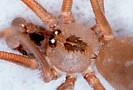
Photo
courtesy Jim Kalisch Department of Entomology
University of Nebraska-Lincoln |
| |
|
| Cellar Spiders
belong to the scientific family Pholcidae. Spiders in this
family typically have extremely long and skinny legs with small
bodies. Common Kentucky species are usually tan or gray. The
web of a cellar spider is usually very messy, similar to the web
of a cobweb spider. Like all spiders, cellar spiders have
8 legs, 2 body parts, and fang-like mouthparts called chelicerae. |
|
| SIZE:
Body length of adult cellar spiders about 1/4" or less |
| |
| LIFE
CYCLE |
|
Simple
metamorphosis: like all spiders, young cellar spiders hatch from
eggs and look like tiny adults. They shed their skin as they
grow. Females lay a few dozen eggs at a time and wrap them
in webbing for protection.
|
| |
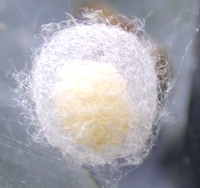 Cellar
Spider Eggs (B. Newton, 2003)
Cellar
Spider Eggs (B. Newton, 2003) |
| ECOLOGY |
|
| |
Cellar spiders often
make their stringy webs indoors, preferring shady corners in basements,
pantries, closets, attics, barns, and sheds. They feed on
small moths, flies, gnats, mosquitoes, and other creatures that
are common in their habitat. When they are not living in buildings,
cellar spiders are sometimes found in protected natural areas, including
caves and rock piles. |
| |
| PEST
STATUS |
|
Cellar
spiders are common in homes, but they typically stay in one place
and don't bother people. They are not known to bite. |
| |
| COMMON
KENTUCKY CELLAR SPIDERS |
|
|
LONG-BODIED
CELLAR SPIDERS
GENUS: Pholcus
In Kentucky, the
most commonly seen spiders in this family are the Long-bodied
Cellar Spiders in the Pholcus genus. Pholcus spiders live all over the world, and are very typical cellar spiders. |
| |
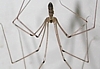
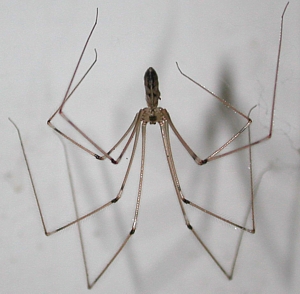 Long-Bodied Cellar
Spider (B. Newton, 2002)
Long-Bodied Cellar
Spider (B. Newton, 2002) |
|
| |
| COLLECTING
& PHOTOGRAPHY |
|
In Kentucky, cellar
spiders are usually present year-round in or near most buildings.
Look around an attic or a basement with a flashlight for a
few minutes and there is a good chance that you will find one. They
are also fairly slow moving, so it is easy to collect one or snap
a picture.
|
| |
| CELLAR
SPIDER FACTS |
|
Some cellar spiders
use a sneaky trick to catch food. When food is scarce, these
cellar spiders abandon their webs and find the webs of other spiders.
They will then tap on the web, mimicking a trapped insect.
When the owner of the web comes to catch its "prey,"
the cellar spider captures and eats it. |
| |
| MYTHS
- LEGENDS - FOLKLORE |
|
Cellar spiders are
also sometimes called "daddy-long-legs spiders," which
is the same name given to the spider-like harvestmen
in the order Opiliones. A widespread myth states that "the
daddy-long-legs is the world's most venomous spider." Although
it is unclear to which creature this myth is referring, it is probably
not true in either case. Read more about this myth at:
http://spiders.ucr.edu/daddylonglegs.html
|
Original document: 25 May 2004
Last updated: 9 May 2011
Close-up cellar spider
photo courtesy Jim Kalisch, Department of Entomology, University of Nebraska-Lincoln.
Other photos courtesy R. Bessin and B. Newton, University of Kentucky
The Kentucky Critter Files are maintained
by Blake Newton, Department of Entomology, University of Kentucky.
Contact: blaken@uky.edu |
|