

New Department of Horticulture Website
The UK Department of Horticulture has a new website at https://horticulture.ca.uky.edu/. Please check out our new website; the old site will remain available temporarily.

The UK Department of Horticulture has a new website at https://horticulture.ca.uky.edu/. Please check out our new website; the old site will remain available temporarily.
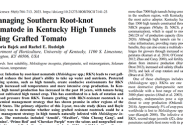
The Rudolph Lab in the Department of Horticulture published an article, Managing Southern Root-knot Nematode in Kentucky High Tunnels Using Grafted Tomato, in the June 2023 issue of the journal HortScience.

August 28, 6:30 p.m. Eastern Time. Topic: Making Cover Crops Work for Your Cut Flower Operation. Speaker: Dr. Krista Jacobsen, Associate Professor, University of Kentucky Department of Horticulture. Dr.

The University of Kentucky's James B. Beam Institute for Kentucky Spirits opened on August 7, 2023. Dr. Seth DeBolt, a professor in the Department of Horticulture, is the institute director.

The University of Kentucky Cooperative Extension Service has launched a community assessment survey to evaluate educational programming and to improve programs and services.
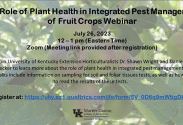
Noon-1 p.m. Eastern Time on July 26. Join University of Kentucky Horticulturalists Shawn Wright and Daniel Becker to learn more about the role of plant health in integrated pest managment.
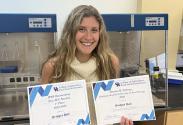
Congratulations to Horticulture graduate student Bridget Bolt who was awarded the 2023 Integrated Plant and Soil Sciences Graduate Program Outstanding Starting Master Student (1st Place) and the Tekrony Seed Biology awards.

Congratulations to Dr. Jia W. Tan who was awarded the Integrated Plant and Soil Sciences Outstanding Continuing PhD student (2nd place) award. Also, Jia recently successfully defended her PhD thesis.
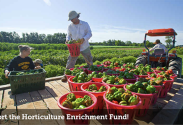
For 24 hours on April 19, 2023, University of Kentucky alumni, faculty, staff, students and friends will support their favorite college, program or cause through One Day for UK - the university's annual giving day.

UK Extension and the Kentucky Horticulture Council are collaborating to characterize the controlled-environment (CEA) growing industry in Kentucky and to ensure the needs of Kentucky's CEA growers are being met.