Recent Research
A complete list of articles with links to pdfs can be found in the CV
Click here to view CV in PDF format
Imitation and emulation by dogs using a bidirectional control procedure.
Holly C. Miller, Rebecca Rayburn-Reeves, Thomas R. Zentall
A successful procedure for studying imitative behavior in non-humans is the bidirectional control procedure in which observers are exposed to a demonstrator that responds by moving a manipulandum in one of two different directions (e.g., left vs. right). Imitative learning is demonstrated when observers make the response in the direction that they observed it being made. This procedure controls for socially mediated effects (the mere presence of a demonstrator), stimulus enhancement (attention drawn to a manipulandum by its movement), and if an appropriate control is included, emulation (learning how the environment works). Recent research with dogs has found that dogs may not demonstrate imitative learning when the demonstrator is human
Read Entire ArticleObject permanence in dogs: Invisible displacement in a rotation task
Holly C. Miller, Cassie D. Gipson, Aubrey Vaughan, Rebecca Rayburn-Reeves, and Thomas R. Zentall
Dogs were tested for object permanence using an invisible displacement in which an object was hidden in one of two containers at either end of a beam and the beam was rotated. Consistent with earlier research, when the beam was rotated 180°, the dogs failed to find the object. However, when the beam was rotated only 90°, they were successful. Furthermore, when the dogs were led either 90° or 180° around the apparatus, they were also successful. In a control condition, when the dogs could not see the direction of the 90° rotation, they failed to find the object...
Read Entire ArticleEpisodic-like memory: Pigeons can report location pecked when unexpectedly asked
Thomas R. Zentall, Rebecca A. Singer, Jessica P. Stagner
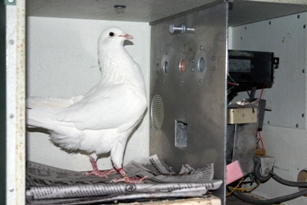
Pigeons were tested for their ability to report the location they recently pecked, without prior experience having to do so. They were first pre-trained to report the location that they had just pecked. They were then trained on a conditional discrimination to associate yellow and blue samples with vertical and horizontal comparisons, respectively, independent of comparison location. On probe trials in testing, when after choosing a vertical or horizontal line following the yellow or blue sample, the pigeons were “asked” which location they had just pecked, they showed a significant tendency to choose correctly in spite of the fact that location of the correct comparison was incidental to the task.
Read Entire ArticleJustification of Effort by Humans and Pigeons: Cognitive Dissonance or Contrast?
Thomas R. Zentall
Justification of effort by humans is a form of reducing cognitive dissonance by enhancing the value of rewards when they are more difficult to obtain. Presumably, assigning greater value to rewards provides justification for the greater effort needed to obtain them. We have found such effects in adult humans and children with a highly controlled laboratory task. More importantly, under various conditions we have found similar effects in pigeons, animals not typically thought to need to justify their behavior to themselves or others. To account for these results, I propose a simpler mechanism than justification of effort–a mechanism based on contrast between the end of the effort and the reinforcement (or signal for reinforcement) that follows. This model predicts that any relatively aversive event can serve to enhance the value of the reward that follows it simply through the contrast between those two events. In support of this general model, my colleagues and I have found this effect in pigeons when the prior event consists of (a) more rather than less effort (pecking), (b) a long rather than a short delay, and (c) the absence of food rather than food. We have also found that a pigeon's preference for food at one location can shift toward a different location if acquiring food at the new location requires that the pigeon work harder to obtain the food. Contrast may also play a role in other social psychological phenomena that have been interpreted in terms of cognitive dissonance.
Read Entire ArticleCoding of Stimuli by Animals:Retrospection, Prospection, Episodic Memory and Future Planning
Thomas R. Zentall
When animals code stimuli for later retrieval they can either code them in terms of the stimulus presented (as a retrospective memory) or in terms of the response or outcome anticipated (as a prospective memory). Although retrospective memory is typically assumed (as in the form of a memory trace), evidence of prospective coding has been found when response intentions and outcomes are particularly salient. At a more abstract level is the question of whether animals are able figuratively to travel back in time to recover memories of past events (episodic memory) and forward in time to predict future events (future planning). Although what would constitute adequate evidence of episodic memory and future planning is controversial, preliminary evidence suggests that animals may be capable of both forms of subjective time travel.
Read Entire ArticleSuboptimal choice behavior by pigeons
Jessica P. Stagner, Thomas R. Zentall
Contrary to the law of effect and optimal foraging theory, pigeons show suboptimal choice behavior by choosing an alternative that provides 20% reinforcement over another that provides 50% reinforcement. They choose the 20% reinforcement alternative when 20% of the time that choice results in a stimulus that always predicts reinforcement and 80% of the time it results in another stimulus that predicts its absence, compared with the 50% reinforcement alternative that results in one of two stimuli that each of which predict reinforcement 50% of the time. This choice behavior may be related to suboptimal human monetary gambling behavior because in both cases the organism overemphasizes the infrequent occurrence of the winning event and underemphasizes the more frequent occurrence of the losing event.
Read Entire Article